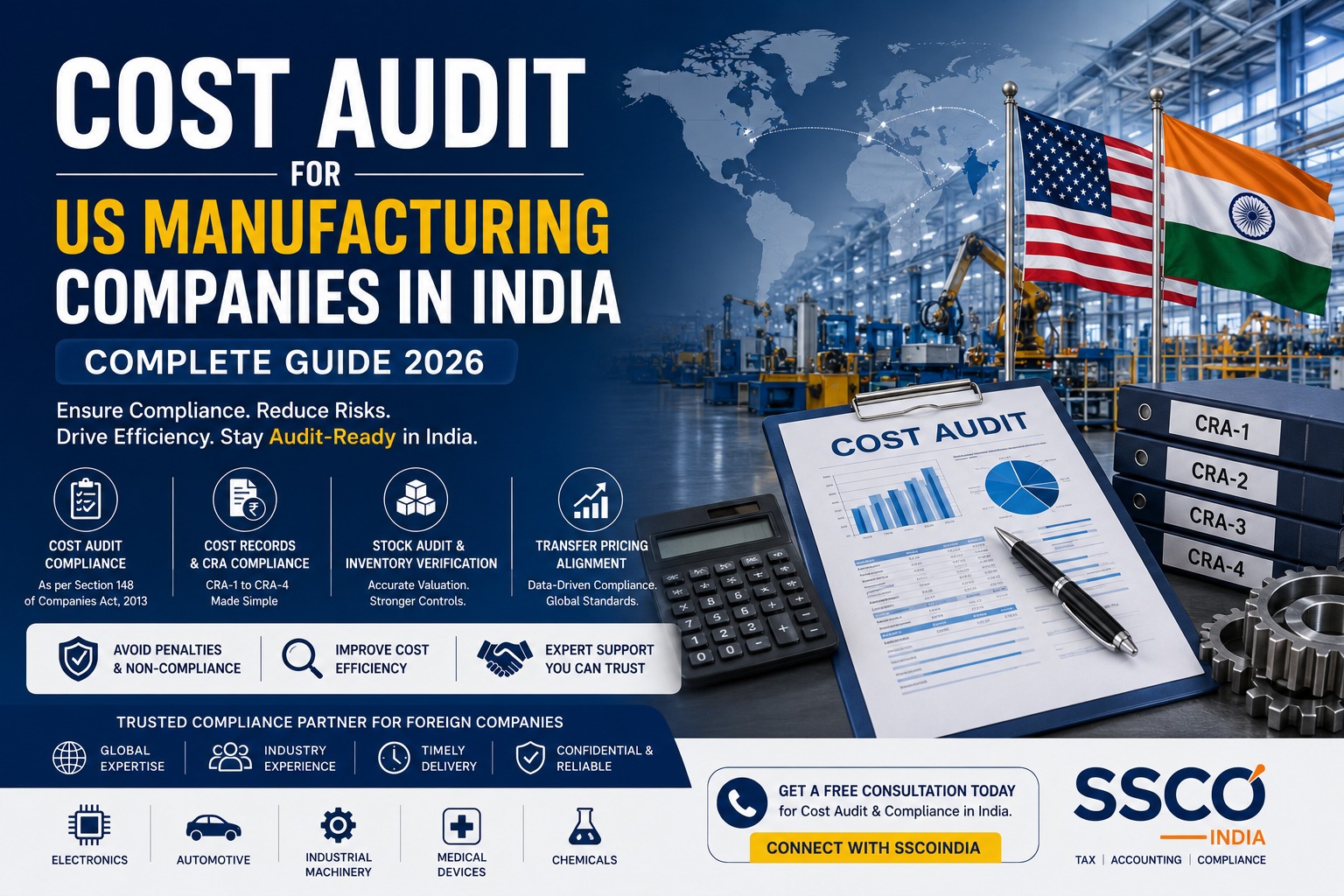
Cost Audit for US Manufacturing Companies in India – Complete Guide (2026)
Why Cost Audit Matters for US Manufacturing Companies in India
India has rapidly become one of the most preferred global manufacturing destinations for US companies. From electronics and automotive components to medical devices and industrial machinery, American businesses are expanding operations in India to benefit from lower production costs, skilled manpower, and growing market demand.
However, setting up or operating a manufacturing business in India also means navigating a complex compliance framework. One of the most important—but often overlooked—requirements is cost audit compliance in India.
“Many US manufacturing companies in India unknowingly fall under mandatory cost audit compliance.”
A cost audit is not just an accounting process. Under Indian regulations, it is a statutory compliance requirement applicable to specific industries and turnover thresholds. Foreign subsidiaries, joint ventures, and manufacturing units owned by US companies may be required to maintain detailed cost records and undergo mandatory audit under the Companies Act, 2013.
Today, Indian regulators closely monitor:
- Manufacturing cost structures
- Inventory valuation
- Transfer pricing arrangements
- Intercompany transactions
- Production efficiency
This is where compliance becomes critical.
US companies operating in India must understand:
- MCA compliance requirements
- CRA rules and filings
- Cost records maintenance obligations
- Regulatory scrutiny risks
- Transfer pricing impact on audit reporting
Failure to comply can result in:
- Monetary penalties
- MCA notices
- Increased compliance scrutiny
- Delays in regulatory approvals
Another major challenge for multinational businesses is aligning:
- US accounting systems
- ERP-generated reports
- Indian cost accounting standards
This often creates inconsistencies in:
- inventory records
- overhead allocation
- cost reconciliation
- transfer pricing documentation
As Indian authorities increasingly focus on compliance transparency, cost audit has become a key area of attention for foreign manufacturing companies.
👉 Whether your company operates through:
- a wholly owned subsidiary
- contract manufacturing unit
- branch office
- joint venture
…it is important to evaluate your cost audit applicability at the earliest stage.
👉 Get expert cost audit support for your US business in India with SSCOIndia.
At SSCOIndia.com, we help US manufacturing companies manage:
✔ Cost audit compliance
✔ CRA-1 to CRA-4 filings
✔ Cost records maintenance
✔ Stock audit
✔ Transfer pricing coordination
✔ MCA reporting support
Our team understands both:
- Indian regulatory requirements
- multinational manufacturing compliance challenges
This ensures your India operations remain:
✅ compliant
✅ audit-ready
✅ risk-free
Why US Manufacturing Companies Are Expanding to India
Over the last few years, India has emerged as one of the most attractive manufacturing destinations for US businesses.
Global supply chain disruptions, rising production costs in other countries, and government-backed industrial reforms have accelerated this shift.
Today, many American companies are:
- setting up manufacturing subsidiaries in India
- outsourcing production to Indian units
- expanding sourcing operations
🇮🇳 India as a Global Manufacturing Hub
India offers several advantages for US manufacturing companies:
✔ Large Skilled Workforce
India provides access to a technically skilled and cost-effective workforce across multiple industries.
✔ Competitive Manufacturing Costs
Lower operational and labour costs make India an attractive alternative for production expansion.
✔ Strategic Market Access
India serves both:
- domestic consumption demand
- export-oriented manufacturing
🚀 Make in India Initiative
The Indian government’s Make in India initiative has encouraged foreign companies to establish manufacturing facilities in sectors such as:
- electronics
- automotive
- engineering
- defense
- medical equipment
The initiative also promotes:
- foreign direct investment (FDI)
- local manufacturing partnerships
- industrial infrastructure development
🔄 Supply Chain Diversification from China
Many US businesses are adopting the “China Plus One” strategy by diversifying operations into India.
As a result, sectors witnessing rapid growth include:
📱 Electronics Manufacturing
Mobile devices, semiconductors, PCB assembly, and industrial electronics.
🚗 Automotive Components
Auto parts, EV components, precision engineering products.
⚙ Industrial Machinery
Heavy machinery, manufacturing equipment, industrial automation systems.
🏥 Medical Devices & Pharma
Healthcare equipment and pharmaceutical manufacturing units.
🧪 Chemicals & Specialty Materials
Industrial chemicals, coatings, specialty compounds.
⚠ Compliance Becomes Critical as Operations Scale
As US companies expand manufacturing operations in India, compliance obligations also increase.
This includes:
- cost records maintenance
- GST compliance
- transfer pricing documentation
- tax audit
- cost audit applicability
Many businesses initially focus only on:
- business setup
- production
- supply chain
…but later discover that Indian cost audit regulations apply to their operations.
This creates significant compliance risk.
👉 SSCOIndia helps US manufacturing companies stay compliant from the beginning—avoiding costly penalties and regulatory issues later.
📜 3. What is Cost Audit in India?
Cost audit in India is a statutory audit conducted to verify the accuracy of cost records and ensure compliance with cost accounting standards prescribed under Indian law.
It is governed by:
- Section 148 of the Companies Act, 2013
- Companies (Cost Records and Audit) Rules
Unlike financial audits, which focus on financial statements, cost audit evaluates:
- production costs
- inventory valuation
- operational efficiency
- cost allocation methods
🎯 Purpose of Cost Audit
The objective of cost audit is to:
- ensure accurate cost reporting
- improve efficiency
- prevent manipulation of cost data
- maintain regulatory transparency
For foreign manufacturing companies, this becomes especially important because:
- intercompany pricing structures are scrutinized
- inventory reporting affects profitability
- production costing impacts transfer pricing
📊 Difference Between Cost Audit, Financial Audit & Internal Audit
| Audit Type | Focus Area |
|---|---|
| Cost Audit | Cost efficiency & cost records |
| Financial Audit | Financial statements |
| Internal Audit | Internal controls & operations |
🔍 What Cost Audit Focuses On
✔ Cost Efficiency
Evaluates production cost optimization and operational efficiency.
✔ Production Records
Verifies manufacturing and process-related cost data.
✔ Inventory Valuation
Checks stock valuation methods and inventory reporting.
✔ Cost Allocation
Ensures proper allocation of:
- labour cost
- utilities
- overheads
- production expenses
👉 For multinational companies, incorrect cost allocation can directly affect:
- transfer pricing documentation
- tax reporting
- profitability analysis
That’s why professional compliance management becomes essential.
👉 SSCOIndia provides specialized cost audit support for US manufacturing companies operating in India.
⚖️ 4. Applicability of Cost Audit for US Manufacturing Companies
This is one of the most important compliance areas for foreign manufacturing businesses in India.
Many US subsidiaries unknowingly become liable for mandatory cost audit under Indian regulations.
📜 Section 148 of Companies Act, 2013
Cost audit applicability is governed under:
Section 148 of the Companies Act, 2013
The law requires certain companies to:
- maintain cost records
- appoint cost auditors
- file prescribed compliance forms
📑 Cost Audit Rules
Applicability depends on:
- sector classification
- turnover threshold
- product category
- overall business activity
🏭 Regulated vs Non-Regulated Sectors
Regulated Sectors
Industries under government-regulated pricing or strategic monitoring.
Non-Regulated Sectors
Manufacturing sectors with specified turnover criteria.
📊 Turnover Thresholds
Cost audit applicability may arise when:
- overall turnover exceeds prescribed limits
- sector-specific revenue thresholds are crossed
🏢 Sectors Relevant to US Manufacturing Companies
📱 Electronics Manufacturing
Semiconductors, industrial electronics, consumer devices.
🚗 Automotive Components
EV parts, precision engineering products.
🧪 Chemicals
Industrial chemicals and specialty materials.
💊 Pharma & Medical Devices
Healthcare manufacturing and pharmaceutical production.
⚙ Engineering Products
Industrial machinery and manufacturing systems.
⚠ Important Warning
“Non-compliance can lead to penalties and increased scrutiny from Indian authorities.”
Failure to comply may result in:
- MCA notices
- financial penalties
- delayed approvals
- audit complications
👉 Unsure whether your US manufacturing subsidiary falls under mandatory cost audit?
👉 Check whether your US subsidiary qualifies for mandatory cost audit with SSCOIndia.
Our experts help foreign companies:
✔ assess applicability
✔ maintain compliance
✔ manage filings
✔ avoid penalties
📑 5. Cost Records Maintenance Requirements (CRA-1)
CRA-1 compliance is one of the most critical obligations for manufacturing companies covered under cost audit rules.
CRA-1 prescribes the format and principles for maintaining cost records in India.
📘 What is CRA-1?
CRA-1 refers to:
Companies (Cost Records and Audit) Rules relating to maintenance of cost records.
Companies covered under applicability must maintain detailed records for:
- production
- inventory
- utilities
- labour
- overhead allocation
📊 Why US Companies Must Maintain Cost Records
Indian regulators expect businesses to maintain:
- transparent cost structures
- accurate production costing
- proper inventory valuation
This becomes even more important for multinational companies because:
- transfer pricing relies on cost data
- intercompany pricing affects tax reporting
📂 Types of Records Required
✔ Raw Material Consumption
Tracking material usage and wastage.
✔ Labour Cost
Employee cost allocation across production activities.
✔ Utilities
Power, fuel, water, and operational utilities.
✔ Production Overheads
Factory expenses and indirect manufacturing costs.
✔ Inventory Records
Stock movement, WIP, finished goods valuation.
⚠ Improper Cost Records = Audit Risk
Incomplete or inaccurate records can trigger:
- audit observations
- compliance notices
- regulatory scrutiny
🔄 ERP Reconciliation Issues in Multinational Companies
Many US businesses face:
- ERP mapping issues
- cost allocation mismatches
- inventory reconciliation errors
because US accounting structures may not align with Indian cost accounting rules.
👉 SSCOIndia helps foreign manufacturing companies maintain audit-ready CRA-1 compliant records aligned with Indian regulations.
🧾 6. CRA-2, CRA-3 & CRA-4 Compliance Explained
Once applicability is established, companies must complete mandatory compliance filings.
📘 CRA-2 – Appointment of Cost Auditor
CRA-2 is filed for:
appointment of cost auditor with MCA.
This filing must be completed within prescribed timelines after board approval.
📘 CRA-3 – Cost Audit Report
CRA-3 contains:
- detailed cost audit observations
- compliance findings
- cost analysis
It is prepared by the cost auditor.
📘 CRA-4 – Submission to MCA
CRA-4 is the final filing submitted to MCA containing:
- cost audit report
- compliance disclosures
⏳ Timelines & Due Dates
Companies must ensure:
- timely auditor appointment
- timely audit completion
- timely filing with MCA
⚠ Late Filing Risks
Delayed filing may lead to:
- penalties
- MCA notices
- compliance scrutiny
👉 SSCOIndia provides end-to-end CRA compliance support for US manufacturing companies in India.
🔄 7. Transfer Pricing & Cost Audit Linkage
Transfer pricing and cost audit are closely interconnected for multinational manufacturing businesses.
🌍 Intercompany Transactions
US manufacturing subsidiaries often engage in:
- import of raw materials
- technology transfer
- royalty payments
- shared services
These transactions directly impact cost structures.
📦 Import Pricing
Incorrect import pricing may affect:
- production cost
- inventory valuation
- profitability analysis
🏢 Shared Service Allocation
Global corporations allocate:
- management cost
- IT expenses
- support services
to Indian subsidiaries.
Improper allocation can create compliance issues.
🔍 Transfer Pricing Scrutiny
Indian authorities increasingly analyze:
- cost records
- intercompany pricing
- profit margins
during assessments.
📊 Impact of Cost Audit Data
Cost audit data influences:
- transfer pricing reports
- profitability analysis
- cost allocation structures
Any mismatch between:
- transfer pricing documents
- cost audit reports
- financial statements
can trigger scrutiny.
👉 SSCOIndia helps US manufacturing companies align transfer pricing and cost audit compliance for smooth regulatory management in India.