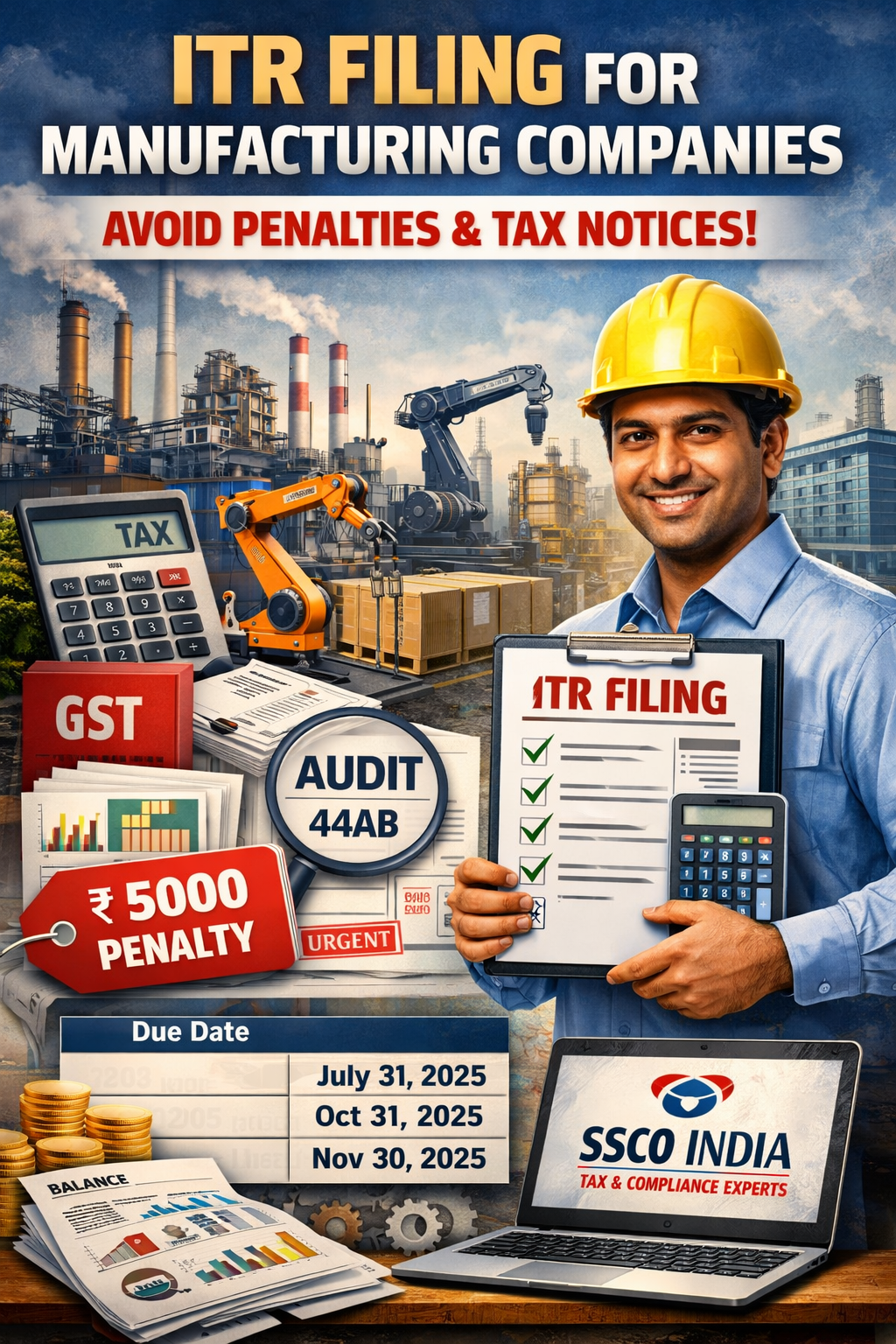
ITR Filing for Manufacturing Companies in India (FY 2024-25)
“Manufacturing businesses face higher compliance risks—one mistake can trigger notices.”
If you run a factory or manufacturing unit, ITR filing for manufacturing companies is not just a yearly formality—it’s a critical compliance requirement that directly impacts your tax liability, audit status, and risk of scrutiny from the Income Tax Department.
Unlike small service-based businesses, manufacturing units deal with complex financial structures, including inventory valuation, raw material costs, machinery depreciation, and GST reporting. This makes income tax return filing for manufacturers far more detailed and sensitive.
Another important factor is the strong linkage between GST and ITR filings. Any mismatch between your GSTR-1, GSTR-3B, and income reported in ITR can raise red flags and lead to notices or scrutiny. Additionally, many manufacturing businesses fall under mandatory tax audit requirements, making compliance even more critical.
The Income Tax Department closely monitors manufacturing companies due to:
- High turnover volumes
- Input-output tax credit claims
- Inventory and expense manipulation risks
This is why choosing professional help is not optional—it’s essential.
👉 At SSCOIndia.com, we specialize in ITR filing for manufacturing businesses, ensuring complete accuracy, GST reconciliation, and audit-ready compliance—so you can focus on running your factory, not handling tax notices.
Who Needs to File ITR in Manufacturing Sector?
Every manufacturing business in India—regardless of size—must file an income tax return based on its structure and turnover. Understanding your category is the first step toward correct compliance.
✔️ Business Types Covered Under Manufacturing ITR Filing
1. Proprietorship Manufacturers
Small factory owners operating under individual names must file ITR-3. These businesses are common in local manufacturing units and MSMEs.
2. Partnership Firms
Manufacturing partnerships must file ITR-5, including detailed profit-sharing and financial disclosures.
3. Limited Liability Partnerships (LLPs)
LLPs engaged in manufacturing also file ITR-5, but with stricter compliance and audit requirements.
4. Private Limited Companies
All registered manufacturing companies must file ITR-6, regardless of profit or loss.
📊 Turnover-Based Classification
Manufacturing businesses are also categorized based on turnover:
- Small Manufacturers → Turnover up to ₹1 crore (may avoid audit under conditions)
- Medium/Large Manufacturers → Turnover above ₹1 crore (audit mandatory in most cases)
With increasing digital transactions, the audit threshold can extend up to ₹10 crore—but most manufacturing units still fall under audit due to cash transactions and operational complexity.
👉 Not sure which category you fall into?
SSCOIndia experts can analyze your business structure and turnover to ensure correct ITR filing and compliance.
Applicable ITR Forms for Manufacturing Companies
Choosing the correct ITR form is crucial. Filing the wrong form can lead to rejection or notices from the Income Tax Department.
Here’s a quick reference table:
| Business Type | Applicable ITR Form |
|---|---|
| Proprietorship Manufacturer | ITR-3 |
| Partnership Firm / LLP | ITR-5 |
| Private Limited Company | ITR-6 |
Each form requires:
- Detailed financial disclosures
- Balance sheet and P&L reporting
- Tax computation
For manufacturing businesses, the complexity increases due to inventory, cost of goods sold, and depreciation calculations.
Avoid costly mistakes—get your ITR filed correctly with SSCOIndia.com, where experts handle form selection, data accuracy, and compliance checks.
ITR Filing Due Dates for Manufacturing Businesses (FY 2024-25)
Meeting deadlines is crucial to avoid penalties and maintain compliance status.
Important Due Dates:
- Without Audit → July 31, 2025
- With Audit → October 31, 2025
- Transfer Pricing Cases → November 30, 2025
Warning: Late filing can result in:
- ₹5,000 penalty under Section 234F
- Interest on unpaid tax
- Loss of certain deductions
- Increased scrutiny risk
Manufacturing businesses often require audits, meaning the October deadline is critical.
Don’t wait till the last minute.
SSCOIndia offers timely filing services with complete audit coordination to ensure zero penalties and stress-free compliance.
Documents Required for ITR Filing (Manufacturing Companies)
Accurate documentation is the backbone of error-free ITR filing.
📂 Essential Documents:
- PAN & Aadhaar
- Profit & Loss Statement
- Balance Sheet
- GST Returns (GSTR-1, GSTR-3B)
- Purchase & Sales Registers
- Inventory / Stock Records
- Audit Report (if applicable)
- Bank Statements
Manufacturing businesses must maintain detailed inventory and expense records, which directly affect profitability and tax calculation.
Pro Tip :
Mismatch between GST returns and ITR data is one of the top reasons for Income Tax notices.
This is where expert reconciliation becomes crucial.
At SSCOIndia.com, we ensure:
- GST & ITR data matching
- Error-free documentation
- Audit-ready financials
Income Calculation for Manufacturing Businesses
Calculating taxable income in manufacturing is more complex than in other sectors.
Key Components:
Revenue
- Sales of finished goods
- Job work income
Other Income
- Scrap sales
- Interest income
- Miscellaneous receipts
Expenses
- Raw material costs
- Labour wages
- Factory overheads
- Electricity & machinery costs
- Depreciation on plant & machinery
Accurate calculation of Cost of Goods Sold (COGS) and inventory valuation plays a major role in determining profits.
Key Insight:
Correct profit calculation = lower tax liability + reduced risk of scrutiny
Even a small miscalculation in expenses or depreciation can increase your tax burden significantly.
With SSCOIndia, you get:
- Expert profit computation
- Smart tax planning
- Maximum allowable deductions
Tax Audit Applicability for Manufacturing Businesses
Tax audit is one of the most important compliance requirements for manufacturers.
When is Audit Required?
- Turnover exceeds ₹1 crore
- Up to ₹10 crore if digital transactions meet specified limits
Section 44AB Explained
Under Section 44AB of the Income Tax Act:
- Businesses exceeding prescribed turnover must undergo a tax audit by a CA
- Audit ensures financial accuracy and compliance
Manufacturing businesses typically fall under audit because:
- High transaction volume
- Inventory valuation complexity
- Expense classification challenges
Failure to comply can result in:
- Heavy penalties
- Disallowance of expenses
- Increased scrutiny
Don’t risk non-compliance.
SSCOIndia provides complete tax audit and ITR filing support for manufacturing companies—ensuring full compliance and peace of mind.
Tax Deductions & Benefits for Manufacturers
One of the biggest advantages for manufacturing businesses is access to multiple tax-saving deductions.
Key Deductions:
Depreciation on Machinery
Claim depreciation on plant & machinery to reduce taxable income.
Additional Depreciation (Section 32)
Manufacturers can claim extra depreciation benefits, significantly lowering tax liability.
MSME Benefits
Eligible businesses can claim deductions and incentives under MSME schemes.
Interest on Loans
Interest paid on business loans is fully deductible.
R&D Deductions
Expenses on research and development qualify for additional tax benefits.
👉 These deductions can save lakhs in taxes—but only if claimed correctly.
Most businesses either:
- Miss deductions
- Claim incorrectly (leading to notices)
👉 With SSCOIndia.com, you get:
- Maximum tax savings
- Accurate deduction claims
- Compliance with latest tax laws
If you’re running a manufacturing business, don’t treat ITR filing as a routine task. One mistake can cost you penalties, notices, and lost profits.
👉 Get your ITR filed by experts at SSCOIndia.com
✔ Accurate filing
✔ GST reconciliation
✔ Tax audit support
✔ Maximum tax savings
📞 Book your consultation today +91 8622086220 and make your business 100% tax compliant and future-ready.
Common Mistakes Manufacturing Companies Make in ITR Filing
When it comes to ITR filing for manufacturing companies, even a small mistake can lead to heavy penalties, tax notices, or scrutiny from the Income Tax Department.
“These mistakes often trigger Income Tax notices”
Let’s look at the most common errors manufacturing businesses make—and why you should avoid them at all costs.
Ignoring Stock Valuation
Inventory is the backbone of any manufacturing business. However, many businesses either:
- Underestimate closing stock
- Use incorrect valuation methods
This directly impacts profit calculation and taxable income. Incorrect stock reporting can raise serious red flags during assessments.
GST Mismatch
One of the biggest triggers for notices is mismatch between:
- GST returns (GSTR-1, GSTR-3B)
- Income reported in ITR
The Income Tax Department cross-verifies GST data. Even a slight mismatch can result in scrutiny or notices.
Wrong Depreciation Claims
Manufacturers heavily invest in machinery and claim depreciation benefits. But:
- Claiming excess depreciation
- Using incorrect rates
- Missing additional depreciation benefits
…can either increase tax liability or attract penalties.
Late Audit Filing
Most manufacturing companies fall under tax audit requirements. Missing audit deadlines can lead to:
- Penalties under Section 271B
- Disallowance of expenses
- Delays in ITR filing
Incorrect Expense Classification
Misclassifying expenses like:
- Capital vs revenue expenditure
- Personal vs business expenses
…can distort your financials and increase scrutiny risk.
The reality?
These mistakes are extremely common—and costly.
Solution:
Avoid errors completely by getting your return filed by professionals at SSCOIndia.com.
✔ GST & ITR reconciliation
✔ Accurate depreciation claims
✔ Audit-ready financials
✔ Zero-error filing
Step-by-Step Process to File ITR for Manufacturing Business
Filing income tax returns for manufacturing businesses can seem complicated—but with the right process, it becomes manageable.
Here’s a simple, actionable step-by-step guide:
Step 1: Collect All Documents
Start by gathering:
- Financial statements (P&L, Balance Sheet)
- GST returns
- Bank statements
- Purchase & sales records
- Audit report (if applicable)
Having complete documents ensures smooth filing.
Step 2: Prepare Financial Statements
Prepare accurate:
- Profit & Loss Account
- Balance Sheet
Ensure:
- Proper inventory valuation
- Correct expense classification
- GST reconciliation
Step 3: Conduct Tax Audit (If Applicable)
If your turnover exceeds limits:
- Get accounts audited under Section 44AB
- Obtain audit report from a Chartered Accountant
This step is mandatory for most manufacturing businesses.
Step 4: Choose the Correct ITR Form
Selecting the right form is critical:
- ITR-3 → Proprietors
- ITR-5 → Firms/LLPs
- ITR-6 → Companies
Wrong form = defective return + possible notice.
Step 5: File ITR on Income Tax Portal
Enter:
- Financial details
- Income & deductions
- Tax computation
Ensure all data matches GST and books of accounts.
Step 6: Verify Your Return
After filing:
- Complete e-verification via Aadhaar OTP / net banking
Without verification, your ITR is considered invalid.
While this process looks simple, in reality it involves technical expertise and compliance checks.
That’s why manufacturing businesses prefer SSCOIndia.com for:
✔ Hassle-free filing
✔ Expert handling
✔ 100% compliance assurance
Why Manufacturing Companies Need Professional Help
Many business owners try to file returns themselves—but manufacturing is not a simple business model.
Complex Compliance Structure
Manufacturers deal with:
- Inventory accounting
- Cost of production
- Depreciation on machinery
- Multiple expense categories
This makes tax filing far more complex than regular businesses.
Audit + GST + ITR Linkage
Manufacturing companies must ensure:
- GST returns match income
- Audit reports align with financials
- ITR reflects correct data
Even one mismatch can trigger scrutiny.
High Risk of Penalties
Errors in:
- Audit compliance
- Tax calculation
- Filing deadlines
…can lead to:
- Heavy penalties
- Interest charges
- Income Tax notices
Why Choose SSCOIndia?
👉 SSCOIndia.com is trusted by businesses across Delhi/NCR for complete tax compliance.
✔ Experts in manufacturing business taxation
✔ Specialized in GST + ITR + audit integration
✔ Local experts in Delhi, Dwarka, Uttam Nagar, NCR
✔ End-to-end compliance handling
Instead of taking risks, let professionals handle your compliance while you focus on growing your business.
CTA – File Your Manufacturing ITR with Experts
Don’t let mistakes, delays, or mismatches cost your business money.
👉 Avoid penalties & notices—file your ITR with experts
👉 Get your manufacturing business ITR filed by professionals
With SSCOIndia.com, you get:
✔ Free consultation
✔ Quick turnaround time
✔ Expert CA support
✔ 100% compliance assurance
📞 Book your consultation today +91 8622086220 and ensure your business stays safe, compliant, and tax-efficient.
FAQs – ITR Filing for Manufacturing Companies
Which ITR form is applicable for manufacturing business?
It depends on your business structure:
- Proprietorship → ITR-3
- Partnership/LLP → ITR-5
- Company → ITR-6
Choosing the correct form is crucial to avoid defective returns.
Is tax audit mandatory for manufacturers?
Yes, if turnover exceeds ₹1 crore (or ₹10 crore under certain conditions), tax audit under Section 44AB is mandatory.
Can I file ITR without audit?
Yes, if your turnover is below the prescribed limit and audit is not applicable. However, accuracy is still critical.
What happens if GST & ITR mismatch?
Mismatch between GST returns and ITR can trigger:
- Income Tax notices
- Scrutiny
- Penalties
Proper reconciliation is essential.
What is the last date for filing ITR for companies?
- With audit → October 31, 2025
- Transfer pricing → November 30, 2025
Missing deadlines can lead to penalties and compliance issues.
Manufacturing businesses operate in a high-compliance environment—and your ITR filing must be perfect.
👉 Don’t take risks.
👉 Don’t wait for notices.
💼 Trust SSCOIndia.com for expert ITR filing, audit support, and complete tax compliance.
📞 Book now and secure your business +91 8622086220 from penalties while maximizing tax savings.
🚀 Get Free Consultation
ITR • GST • Cost Audit Experts