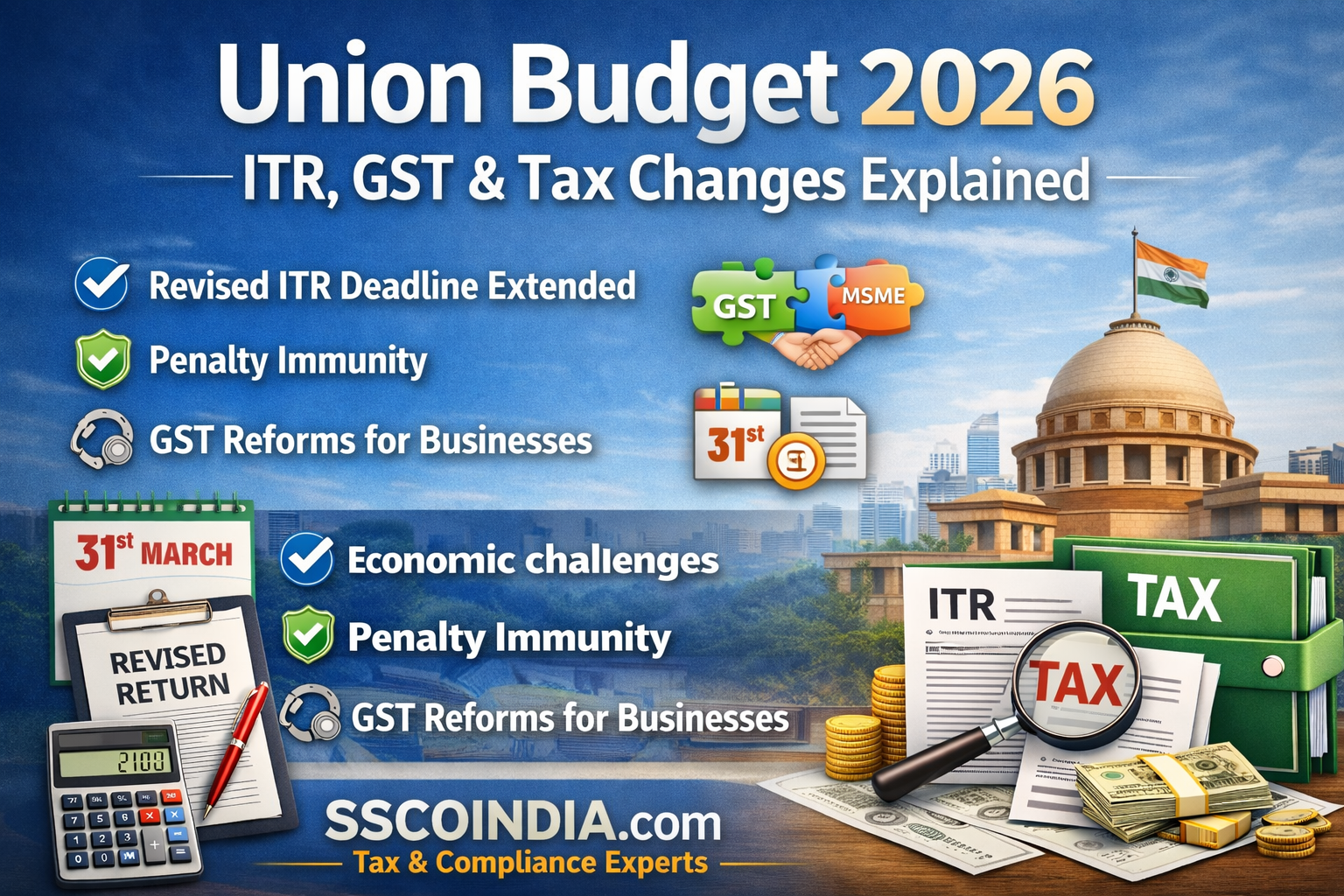
Union Budget 2026 Explained: Why It Is a Turning Point for Indian Taxpayers
The Union Budget 2026 is not just another annual financial statement—it represents a fundamental shift in India’s taxation approach. For years, taxpayers associated income tax and GST compliance with fear, penalties, notices, and long litigation. Budget 2026 changes this narrative by placing trust, flexibility, and voluntary compliance at the centre of tax administration.
The government has clearly acknowledged that most tax errors arise from complexity, delayed information, or lack of professional guidance—not intentional evasion. As a result, Budget 2026 introduces reforms that directly impact ITR filing, GST compliance, TDS/TCS, litigation, and overall tax strategy.
Salaried individuals must now reassess how they report multiple income sources. MSMEs and professionals need to realign compliance systems with new relaxations. Businesses and corporates must revisit tax planning, MAT, and GST cash-flow strategies. Simply put, everyone who files a return or pays tax is affected.
Budget 2026 does not eliminate responsibility—but it rewards honesty, timely correction, and proactive compliance.
Big Picture: Taxation Philosophy of Budget 2026
At its core, Budget 2026 reflects a clear philosophical change:
from penalty-driven enforcement to voluntary, trust-based compliance.
From Fear to Cooperation
Earlier, even small mismatches could lead to prosecution or heavy penalties. Budget 2026 replaces this with structured opportunities to correct mistakes without fear, provided there is no deliberate misreporting.
Key Focus Areas
The new taxation philosophy revolves around:
-
Ease of doing business – especially for MSMEs and startups
-
Ease of living – simplified compliance for individuals
-
Reduced litigation – fewer disputes, faster closure
-
Digitisation & automation – rule-based systems instead of discretion
Practical Meaning for Taxpayers
For taxpayers, this means:
-
More time to correct errors
-
Lower risk of criminal consequences
-
Reduced compliance anxiety
-
Greater importance of accuracy and documentation
However, relaxed rules still require correct interpretation, which is where professional guidance becomes crucial.
Major Income Tax Reforms Introduced in Budget 2026
Budget 2026 introduces a series of income tax reforms designed to simplify compliance while maintaining accountability.
Key Income Tax Proposals
-
Extended timelines for revised and updated returns
-
Immunity from penalty and prosecution in eligible cases
-
Decriminalisation of procedural lapses
-
Automated systems for lower/nil TDS certificates
-
Rationalisation of TDS and TCS rates
Compliance Relaxation vs Accountability
The budget relaxes procedural harshness, not tax liability. Income must still be disclosed correctly, taxes paid fully, and records maintained.
Impact Across Taxpayer Categories
-
Individuals: Less fear, more flexibility
-
Small businesses: Lower litigation risk
-
Professionals: Safer corrections and disclosures
-
Corporates: Clearer rules on MAT, buybacks, and reporting
ITR Filing After Budget 2026: What Has Changed
The most visible impact of Budget 2026 is on ITR filing after Budget 2026.
New Approach to ITR Filing
The system now assumes good faith, allowing taxpayers to fix errors rather than punishing them immediately.
Reduced Fear of Prosecution
Criminal prosecution is no longer the first response to procedural mistakes, which encourages honest disclosures.
Greater Flexibility for Corrections
Taxpayers can now revise or update returns even after discovering mistakes late in the year.
Why Reviewing Old ITRs Is Crucial
Many taxpayers may have:
-
Missed income
-
Claimed incorrect deductions
-
Faced TDS mismatches
Budget 2026 provides a rare opportunity to revisit and correct past filings safely.
Revised & Updated Return Timelines Explained
One of the most searched changes is the revised return deadline extended till 31st March.
Types of Returns Explained
-
Original Return: Filed within the standard due date
-
Revised Return: Corrects errors in original return
-
Updated Return: Declares missed income later with additional tax
Who Should File What?
-
Salaried employees: Correct interest income or deductions
-
Businesses: Update turnover or expense figures
-
Freelancers: Declare missed client income
This extended timeline reduces rushed filings and improves accuracy.
Immunity from Penalty & Prosecution: A Game Changer
Penalty vs Prosecution
-
Penalty: Monetary fine
-
Prosecution: Criminal proceedings
New Immunity Framework
Budget 2026 allows immunity where:
-
Errors are unintentional
-
Income is voluntarily corrected
-
No misreporting is involved
Under-Reporting vs Misreporting
-
Under-reporting: Genuine mistake → eligible for immunity
-
Misreporting: Deliberate concealment → no immunity
Correct classification is critical and often requires expert evaluation.
Decriminalisation of Procedural Lapses
Earlier, non-production of books of account could trigger prosecution. This created fear among MSMEs and professionals.
What Has Changed
-
Non-production is no longer a criminal offence
-
Monetary consequences may still apply
Why Records Still Matter
Books remain essential for:
-
Defending assessments
-
Claiming deductions
-
Avoiding additions
Decriminalisation reduces fear, not responsibility.
TDS & TCS Changes Announced in Budget 2026
Reduced TCS Rates
-
Foreign travel
-
Education
-
Medical purposes
Other Key Changes
-
Automated lower/nil TDS certificates
-
TDS on manpower services at 1% / 2%
Impact
These changes improve cash flow for individuals and businesses, but incorrect application can still cause mismatches.
Who Should Take Immediate Action on ITR After Budget 2026
Immediate review is recommended for:
-
Salaried employees with multiple income sources
-
Small businesses and traders
-
Freelancers and consultants
-
Taxpayers facing notices or reassessment
-
Late or incorrect filers
GST Outlook in Budget 2026
There is no major rate overhaul, but strong signals of simplification, automation, and trust-based enforcement.
GST Reforms for MSMEs in Budget 2026
-
Mandatory TReDS for CPSEs
-
Invoice discounting via CGTMSE
-
Improved liquidity and GST cash-flow management
GST Compliance & Ease of Doing Business
-
Reduced verification for compliant taxpayers
-
Risk-based assessments
-
Lower scrutiny for honest businesses
Customs & Indirect Tax Measures
-
Duty exemptions for manufacturing and exports
-
SEZ-related relaxations
-
Benefits for GST-registered exporters and importers
MAT, Capital Gains & Corporate Tax
-
MAT proposed as final tax
-
Restricted MAT credit utilisation
-
Buyback taxation changes impacting promoters
Foreign Income & Non-Resident Measures
-
One-time foreign asset disclosure scheme
-
Immunity for small-value foreign assets
-
Relief for NRIs and global professionals
Reduction in Litigation & Dispute Resolution
-
Settlement mechanisms
-
Immunity from prosecution in eligible cases
-
Faster closure of long-pending disputes
Step-by-Step Taxpayer Action Plan
-
Review past filings
-
Reconcile AIS & Form 26AS
-
Identify correction scope
-
Decide on professional support
-
Act before 31st March
Common Tax Mistakes Budget 2026 Helps You Fix
-
Late filing
-
TDS mismatches
-
Incorrect deductions
-
Non-disclosure of income
-
Panic-driven non-compliance
Why Professional Tax Support Matters More Than Ever
Automation reduces discretion, not errors. Misinterpretation can still trigger notices. Long-term compliance requires structured planning.
How SSCOIndia Can Help You Navigate Budget 2026
-
ITR filing for individuals & businesses
-
Revised and updated return filing
-
GST registration & return filing
-
Notice handling & reassessment support
-
End-to-end tax and compliance advisory
Conclusion: Budget 2026 Is an Opportunity—If You Act in Time
Budget 2026 rewards honesty, correction, and proactive compliance. But benefits are time-bound and condition-based.
Act before deadlines
Correct mistakes confidently
Choose SSCOIndia for stress-free, expert-led tax compliance