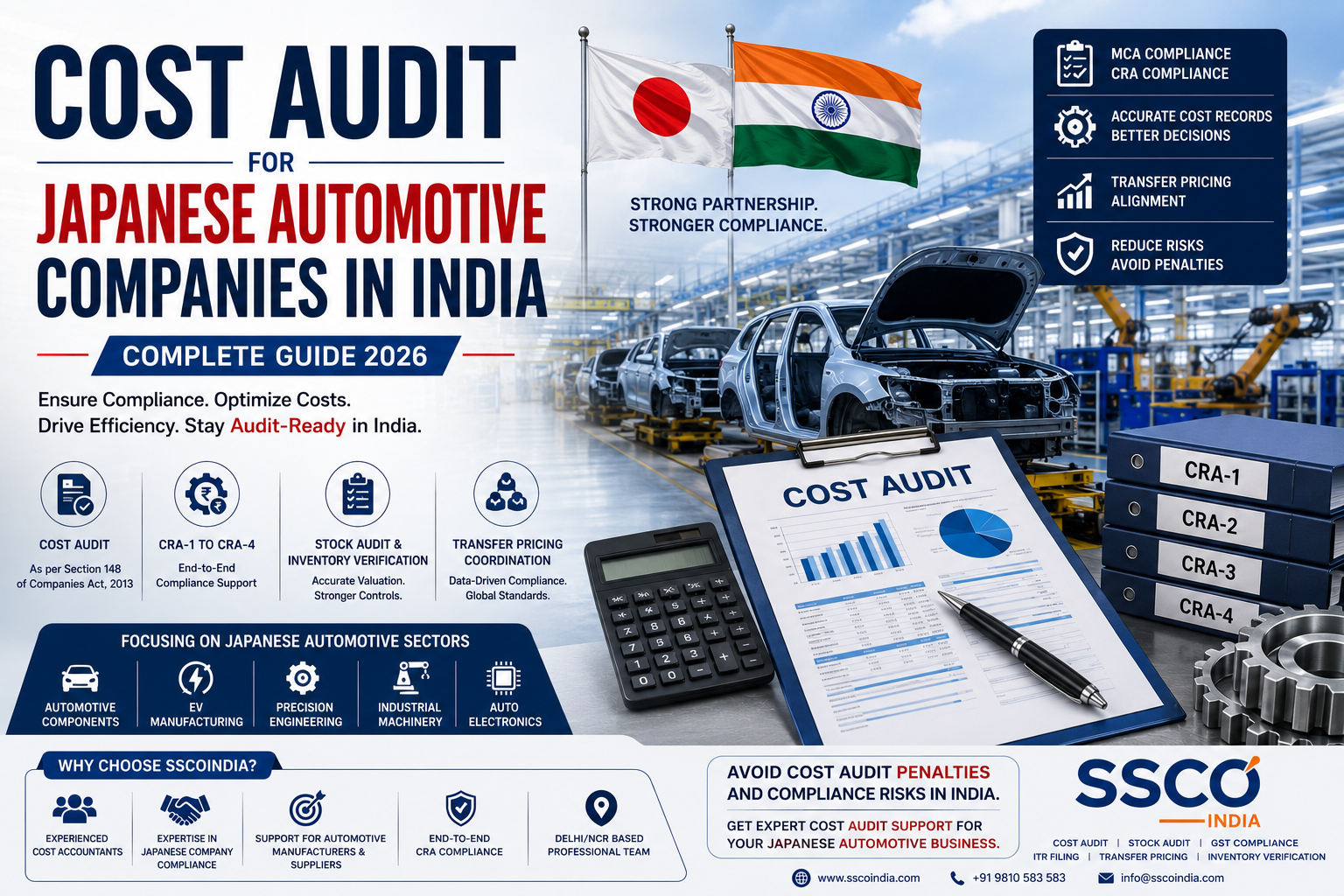
Cost Audit for Japanese Automotive Companies in India – Complete Guide (2026)
Why Cost Audit Matters for Japanese Automotive Companies in India
India has become one of the largest automotive manufacturing destinations in the world, attracting major Japanese automotive manufacturers, auto component suppliers, and engineering companies. From vehicle assembly plants to EV component manufacturing and precision engineering operations, Japanese companies continue expanding their footprint across India.
However, operating a manufacturing business in India involves much more than production efficiency and supply chain management. Japanese automotive businesses must also comply with India’s complex regulatory and cost accounting framework.
This is where cost audit for Japanese automotive companies in India becomes critically important.
“Many Japanese automotive companies in India unknowingly fall under mandatory cost audit and CRA compliance requirements.”
Indian authorities closely monitor manufacturing businesses engaged in:
- automotive production
- engineering products
- industrial manufacturing
- EV component manufacturing
Under the Companies Act, 2013 and Cost Audit Rules, certain companies are required to:
- maintain detailed cost records
- appoint cost auditors
- submit CRA filings
- comply with cost accounting standards
For Japanese automotive companies operating in India, compliance challenges become even more complex because of:
- transfer pricing structures
- imported component pricing
- inventory valuation
- production overhead allocation
- intercompany transactions
Today, Indian regulators focus heavily on:
- MCA compliance
- cost accounting regulations
- inventory & production cost verification
- transfer pricing scrutiny
- manufacturing sector compliance risks
As Japanese companies expand manufacturing operations in India, regulatory scrutiny also increases. Even highly efficient multinational businesses may face compliance risks if Indian cost audit rules are not properly understood and implemented.
Many Japanese manufacturers use advanced ERP systems and global reporting structures, but Indian compliance regulations require:
- localized cost records
- prescribed reporting formats
- CRA-based filings
- detailed inventory verification
Failure to comply may result in:
- MCA notices
- monetary penalties
- audit observations
- compliance scrutiny
This is especially important in the automotive sector, where businesses manage:
- large inventory volumes
- complex supply chains
- multi-location warehouses
- imported components
- vendor ecosystems
👉 Whether your company is engaged in:
- automotive manufacturing
- EV production
- precision engineering
- industrial machinery
- auto electronics
…it is essential to evaluate cost audit applicability at the earliest stage.
👉 Get expert cost audit support for your Japanese automotive business in India with SSCOIndia.
At SSCOIndia.com, we help Japanese manufacturing companies manage:
✔ cost audit compliance
✔ CRA-1 to CRA-4 filings
✔ stock audit & inventory verification
✔ transfer pricing coordination
✔ GST & ITR compliance
✔ manufacturing audit support
Our team understands both:
- Indian regulatory requirements
- multinational automotive manufacturing structures
This helps your business remain:
✅ compliant
✅ audit-ready
✅ operationally efficient
🇯🇵 2. Why Japanese Automotive Companies Are Expanding in India
India has become one of the most important strategic destinations for Japanese automotive businesses.
Over the last decade, Japanese companies have significantly increased investments in:
- manufacturing plants
- industrial corridors
- vendor development
- EV ecosystem expansion
🚘 India as a Major Automotive Manufacturing Hub
India is now among the world’s fastest-growing automotive manufacturing markets.
The country offers:
- strong domestic demand
- skilled engineering workforce
- cost-efficient manufacturing
- export opportunities
This makes India highly attractive for Japanese automotive companies seeking long-term production and supply chain expansion.
⚡ Growth of EV & Auto Component Sector
India’s electric vehicle (EV) market is expanding rapidly.
Japanese businesses are investing heavily in:
- EV components
- battery systems
- precision automotive parts
- industrial electronics
As EV manufacturing grows, cost structures become increasingly complex, making compliance and cost audit more important than ever.
🤝 India-Japan Industrial Collaboration
India and Japan continue strengthening industrial partnerships through:
- manufacturing initiatives
- infrastructure investments
- technology collaborations
- automotive sector partnerships
Japanese automotive companies often establish:
- wholly owned subsidiaries
- joint ventures
- supplier ecosystems
- industrial manufacturing units
across India.
🔄 Supply Chain Diversification Strategy
Global supply chain disruptions have encouraged many Japanese businesses to diversify operations outside traditional manufacturing regions.
India has emerged as a preferred destination because of:
- production scalability
- improving infrastructure
- policy support
- industrial ecosystem growth
🏭 Industries Driving Japanese Expansion in India
🚗 Automotive Components
Engine parts, transmission systems, braking systems, EV components.
⚡ EV Manufacturing
Battery components, electronic systems, electric drivetrain parts.
⚙ Precision Engineering
High-precision manufacturing and industrial production systems.
🏗 Industrial Machinery
Manufacturing equipment and industrial automation systems.
📱 Auto Electronics
Sensors, control systems, semiconductor-based automotive electronics.
⚠ Compliance Becomes Critical as Operations Scale
As manufacturing operations expand, compliance obligations also increase significantly.
Japanese automotive companies must manage:
- cost records maintenance
- inventory verification
- transfer pricing documentation
- GST compliance
- cost audit applicability
Many businesses initially focus only on:
- production efficiency
- vendor development
- operational scaling
…but later discover that Indian cost audit rules apply to their manufacturing activities.
This creates:
- regulatory risk
- compliance pressure
- audit complications
👉 SSCOIndia helps Japanese automotive businesses stay compliant from the beginning and avoid costly compliance issues later.
🚘 3. Overview of Japanese Automotive Industry Presence in India
Japanese automotive companies have established one of the strongest foreign manufacturing ecosystems in India.
Today, India hosts:
- Japanese OEM manufacturers
- tier-1 auto component suppliers
- industrial manufacturing facilities
- engineering production units
across major automotive hubs.
🏭 Japanese OEM Manufacturers in India
Japanese automotive brands have large-scale manufacturing operations across:
- vehicle assembly
- engine production
- EV component manufacturing
- industrial engineering
These businesses operate through:
- subsidiaries
- joint ventures
- manufacturing partnerships
🔩 Auto Component Supplier Ecosystem
Japanese auto component manufacturers support:
- OEM assembly plants
- export manufacturing
- EV production systems
The supplier ecosystem includes:
- electronics manufacturers
- precision engineering businesses
- industrial tooling companies
- component vendors
🏗 Manufacturing Plants & Industrial Corridors
Japanese companies are heavily concentrated in:
- industrial corridors
- automotive clusters
- export manufacturing zones
These facilities often operate:
- multiple warehouses
- centralized procurement systems
- intercompany manufacturing structures
which increases cost audit complexity.
🤝 Vendor Ecosystem in India
Japanese manufacturing businesses rely on extensive vendor networks for:
- raw materials
- industrial components
- outsourced production
- logistics support
This creates significant challenges in:
- cost allocation
- inventory management
- production cost verification
📊 Strong Operational Standards—but Different Compliance Rules
Japanese companies are globally known for:
✔ operational discipline
✔ detailed cost structures
✔ efficient inventory systems
✔ lean manufacturing processes
However, Indian compliance requirements differ significantly from Japanese accounting and audit frameworks.
Indian regulations require:
- CRA-based reporting
- cost records maintenance
- inventory verification
- cost allocation disclosures
Failure to align operations with Indian compliance standards may create:
- audit observations
- filing delays
- compliance notices
👉 SSCOIndia helps Japanese automotive companies align global operational systems with Indian regulatory requirements.
📜 4. What is Cost Audit in India?
Cost audit is a statutory compliance process conducted under Indian law to verify:
- accuracy of cost records
- inventory valuation
- production costing
- overhead allocation
- operational efficiency
It is governed under:
Section 148 of the Companies Act, 2013
and related Cost Audit Rules.
🎯 Role of Cost Audit in Manufacturing Sector
Cost audit plays a critical role in manufacturing industries because it helps:
- improve cost transparency
- verify production costs
- strengthen inventory controls
- support regulatory compliance
For automotive businesses, cost audit becomes especially important due to:
- large-scale manufacturing
- imported components
- intercompany pricing structures
- inventory-heavy operations
📊 Difference Between Cost Audit, Financial Audit & Internal Audit
| Audit Type |
Primary Focus |
| Cost Audit |
Cost records & production efficiency |
| Financial Audit |
Financial statements |
| Internal Audit |
Internal processes & controls |
🔍 What Cost Audit Focuses On
✔ Production Cost Accuracy
Verification of manufacturing cost structures.
✔ Cost Efficiency
Analysis of operational efficiency and production processes.
✔ Inventory Valuation
Validation of stock and inventory costing methods.
✔ Overhead Allocation
Review of utility, labour, and production overhead distribution.
✔ Operational Controls
Assessment of manufacturing and cost reporting systems.
For Japanese automotive companies, incorrect cost allocation or inventory reporting can directly affect:
- transfer pricing documentation
- profitability analysis
- regulatory reporting
👉 SSCOIndia provides specialized cost audit services for Japanese automotive manufacturers operating in India.
⚖️ 5. Applicability of Cost Audit for Japanese Automotive Companies
This is one of the most critical compliance areas for Japanese manufacturing businesses in India.
Many companies unknowingly fall under mandatory cost audit applicability due to:
- turnover thresholds
- manufacturing sector classification
- engineering product coverage
📜 Section 148 of Companies Act
Cost audit applicability is governed under:
Section 148 of the Companies Act, 2013
Companies meeting prescribed criteria must:
- maintain cost records
- appoint cost auditor
- complete CRA compliance filings
📑 Cost Audit Rules
Applicability depends on:
- industry classification
- turnover level
- product category
- manufacturing activity
🏭 Regulated vs Non-Regulated Sectors
Regulated Sectors
Industries with government-monitored pricing or strategic significance.
Non-Regulated Sectors
Manufacturing industries covered under prescribed turnover limits.
📊 Turnover Thresholds & Industry Coverage
Japanese automotive businesses may become liable based on:
- company turnover
- sector-specific revenue
- manufacturing activities
🚗 Automotive & Engineering Sectors Commonly Covered
✔ Auto Components
Engine systems, braking systems, drivetrain components.
✔ EV Components
Battery systems, EV electronics, charging systems.
✔ Precision Manufacturing
Industrial engineering and advanced manufacturing systems.
✔ Engineering Products
Industrial machinery and production equipment.
⚠ Important Compliance Warning
“Failure to comply with cost audit regulations can lead to penalties and increased scrutiny from Indian authorities.”
Non-compliance may result in:
- MCA notices
- financial penalties
- operational delays
- audit scrutiny
👉 Unsure whether your company falls under cost audit applicability?
👉 Check whether your Japanese automotive company falls under mandatory cost audit applicability with SSCOIndia.
Our experts help businesses:
✔ evaluate applicability
✔ maintain compliance
✔ manage filings
✔ avoid penalties
📑 6. CRA-1 Cost Records Maintenance Requirements
CRA-1 compliance is one of the most important obligations for manufacturing companies in India.
📘 What is CRA-1?
CRA-1 defines the rules for maintaining cost records under Indian regulations.
Applicable companies must maintain records relating to:
- production cost
- inventory movement
- utilities
- labour allocation
- manufacturing overheads
🚗 Importance of Cost Records for Automotive Companies
Automotive businesses manage:
- large-scale inventory
- imported components
- complex vendor systems
- multi-stage manufacturing
Proper cost records help:
- improve audit readiness
- strengthen compliance
- support transfer pricing reporting
📂 Required Records
✔ Raw Material Usage
Tracking consumption and wastage.
✔ Labour Cost
Employee and production labour allocation.
✔ Utilities
Power, fuel, water, and operational expenses.
✔ Production Overheads
Factory and indirect manufacturing expenses.
✔ Inventory Records
Stock movement, WIP, finished goods valuation.
✔ Machine Utilization
Production efficiency and operational reporting.
🔄 ERP Localization Challenges
Japanese manufacturers often use advanced ERP systems that require localization for Indian compliance reporting.
This creates challenges in:
- cost classification
- reporting structure
- reconciliation
- inventory mapping
⚠ Compliance Risk Warning
Improper cost records may create:
- audit observations
- filing issues
- compliance scrutiny
👉 SSCOIndia helps Japanese automotive companies maintain CRA-1 compliant records aligned with Indian regulations.
🧾 7. CRA-2, CRA-3 & CRA-4 Compliance Process
Once applicability is established, companies must complete mandatory CRA filings.
📘 CRA-2 – Appointment of Cost Auditor
CRA-2 is filed with MCA for:
appointment of cost auditor.
This filing must be completed within prescribed timelines after board approval.
📘 CRA-3 – Cost Audit Report
CRA-3 includes:
- cost audit findings
- cost analysis
- compliance observations
- production cost reporting
📘 CRA-4 – Submission to MCA
CRA-4 is the final filing submitted to MCA containing:
- cost audit report
- compliance disclosures
⏳ Timelines & Filing Deadlines
Companies must ensure:
- timely appointment of auditor
- timely completion of audit
- timely CRA filings
⚠ Late Filing Risks
Delayed filing may result in:
- penalties
- MCA notices
- compliance complications
- audit scrutiny
👉 SSCOIndia provides end-to-end CRA compliance support for Japanese automotive companies operating in India.
8. Transfer Pricing & Cost Audit Linkage for Japanese Companies
For Japanese automotive companies operating in India, transfer pricing and cost audit are deeply interconnected compliance areas. As multinational automotive groups manage cross-border manufacturing operations, Indian authorities closely evaluate intercompany transactions, cost allocation structures, and profitability reporting.
This makes transfer pricing and cost audit compliance for Japanese companies in India one of the most important regulatory concerns for automotive manufacturers and component suppliers.
Japanese multinational structures often involve complex cross-border pricing arrangements that directly impact:
- production costing
- inventory valuation
- profitability analysis
- tax reporting
- cost audit disclosures
Today, Indian regulators increasingly compare:
- transfer pricing documentation
- cost audit reports
- GST filings
- financial statements
to identify inconsistencies and compliance risks.
🌍 Intercompany Transactions in Automotive Manufacturing
Japanese automotive businesses operating in India commonly engage in:
- import of raw materials
- purchase of auto components
- centralized procurement systems
- royalty payments
- management fee allocation
These intercompany arrangements affect:
- production cost structures
- inventory valuation
- transfer pricing margins
Incorrect classification or allocation may trigger:
- tax scrutiny
- audit observations
- compliance notices
🚗 Import of Auto Components
Many Japanese automotive manufacturers import:
- engine systems
- electronics
- precision components
- EV modules
- industrial machinery parts
from overseas group companies.
Import pricing significantly impacts:
- manufacturing cost
- inventory valuation
- gross margin analysis
- profitability benchmarking
Indian authorities may review whether imported component pricing aligns with:
- arm’s length principles
- transfer pricing regulations
- cost audit reporting
💴 Royalty Payments & Technology Transfer
Japanese automotive businesses often operate through:
- technology transfer agreements
- licensing arrangements
- royalty-based manufacturing models
Royalty payments for:
- brand usage
- manufacturing technology
- patents
- engineering systems
must be properly reflected in:
- cost records
- transfer pricing documentation
- profitability calculations
Improper allocation of royalty expenses may create compliance complications during assessments.
🏢 Shared Service Allocation
Global automotive groups frequently allocate:
- management support costs
- IT services
- procurement support
- engineering assistance
to Indian subsidiaries.
These allocations directly affect:
- cost allocation
- production costing
- margin benchmarking
If shared service expenses are not properly documented, authorities may question:
- cost accuracy
- transfer pricing methodology
- profit allocation structure
📊 How Cost Audit Impacts Transfer Pricing Reports
Cost audit plays a critical role in validating:
- manufacturing cost structures
- operational profitability
- inventory valuation
- production overhead allocation
This data is often used during:
- transfer pricing assessments
- benchmarking analysis
- profitability reviews
💰 Cost Allocation & Profitability Analysis
Automotive manufacturing involves multiple layers of cost allocation, including:
- labour expenses
- utilities
- machine utilization
- production overheads
- inventory carrying cost
Incorrect cost allocation may distort:
- transfer pricing reports
- segment profitability
- margin calculations
This creates regulatory risk for multinational automotive businesses.
📈 Margin Benchmarking Risks
Indian tax authorities often compare:
- profitability margins
- operational cost structures
- intercompany pricing patterns
with industry benchmarks.
If margins appear inconsistent with:
- production scale
- inventory structure
- manufacturing operations
it may lead to:
- transfer pricing scrutiny
- audit review
- compliance investigation
👉 SSCOIndia helps Japanese automotive companies align transfer pricing documentation with cost audit compliance requirements in India.
Our experts provide:
✔ cost audit support
✔ transfer pricing coordination
✔ profitability analysis
✔ inventory valuation review
✔ compliance risk assessment
to ensure smooth regulatory compliance for multinational automotive businesses.
📦 9. Stock Audit & Inventory Verification for Automotive Manufacturers
Inventory management is one of the most critical compliance and operational areas for automotive manufacturing businesses in India.
Japanese automotive companies manage:
- large inventory volumes
- imported components
- multi-location warehouses
- complex production cycles
This makes stock audit and inventory verification for automotive manufacturers extremely important for both:
- compliance management
- operational efficiency
🚘 Importance of Stock Audit in Automotive Manufacturing
Automotive businesses deal with thousands of inventory items, including:
- raw materials
- imported components
- spare parts
- WIP inventory
- finished goods
Stock audit helps companies:
✔ verify inventory accuracy
✔ reduce stock discrepancies
✔ strengthen internal controls
✔ improve audit readiness
✔ support cost audit reporting
For Japanese manufacturers known for lean inventory systems, maintaining accurate stock records becomes essential under Indian compliance regulations.
📊 Inventory Valuation Challenges
Inventory valuation in automotive manufacturing is highly complex due to:
- fluctuating import pricing
- component variation
- multiple production stages
- vendor-based inventory systems
Incorrect inventory valuation may affect:
- profitability analysis
- transfer pricing reports
- cost audit findings
- financial reporting
This is especially important for:
- EV manufacturing
- precision engineering
- industrial machinery production
🔩 Spare Parts Tracking
Automotive businesses maintain large inventories of:
- spare parts
- imported assemblies
- replacement components
- production tools
Tracking these items accurately is essential for:
- inventory verification
- production costing
- audit reporting
Improper tracking often creates:
- stock mismatch
- valuation errors
- audit observations
⚙ WIP (Work-in-Progress) Valuation Challenges
WIP valuation is one of the most sensitive areas in automotive manufacturing.
Incorrect WIP reporting may distort:
- production cost
- inventory value
- profitability calculations
Japanese automotive companies often operate:
- multi-stage production systems
- assembly-line manufacturing
- vendor-integrated production processes
which increases valuation complexity.
🔍 Physical Stock Verification
Physical stock verification is essential to validate:
- actual inventory position
- warehouse accuracy
- ERP records
- inventory reconciliation
Automotive companies commonly operate:
- multiple warehouses
- regional stock points
- centralized inventory systems
This increases audit and verification complexity.
⚠ Compliance Warning
Mismatch between inventory and financial records may trigger audit observations.
Indian authorities may compare:
- stock records
- cost audit reports
- GST filings
- financial statements
to identify inconsistencies.
👉 SSCOIndia provides professional stock audit and inventory verification services for Japanese automotive manufacturers operating in India.
Our team helps businesses:
✔ improve inventory controls
✔ strengthen stock reconciliation
✔ align ERP records with Indian regulations
✔ maintain audit-ready inventory documentation
⚠️ 10. Common Compliance Mistakes Japanese Automotive Companies Make
Many Japanese automotive companies operating in India maintain strong operational systems, but Indian compliance regulations involve unique statutory requirements that are often misunderstood or overlooked.
“These mistakes often trigger regulatory notices and audit complications.”
❌ Ignoring Cost Audit Applicability
One of the biggest compliance risks is assuming that cost audit rules apply only to Indian-owned businesses.
In reality, foreign-owned automotive manufacturing companies may also fall under mandatory applicability based on:
- turnover
- manufacturing activity
- sector classification
❌ Delayed CRA Filings
Late filing of:
can lead to:
- MCA notices
- penalties
- compliance scrutiny
Delays often happen because foreign management teams are unfamiliar with Indian filing timelines.
❌ Incorrect Inventory Valuation
Improper valuation of:
- imported components
- WIP inventory
- spare parts
- obsolete stock
can create:
- cost audit observations
- transfer pricing inconsistencies
- financial reporting issues
❌ Transfer Pricing Inconsistencies
Mismatch between:
- intercompany pricing
- cost records
- profitability analysis
- transfer pricing reports
may attract regulatory attention.
❌ ERP Reconciliation Mismatch
Japanese automotive companies frequently use global ERP systems that may not fully align with Indian compliance formats.
This creates issues in:
- inventory reconciliation
- cost classification
- production reporting
- audit disclosures
❌ Improper Overhead Allocation
Incorrect allocation of:
- utilities
- labour cost
- machine utilization
- shared services
can distort:
- production costing
- profitability margins
- cost audit reports
👉 SSCOIndia helps Japanese automotive businesses identify and resolve compliance gaps before they become major regulatory risks.
💰 11. Penalties for Non-Compliance
Failure to comply with Indian cost audit and CRA regulations can create serious financial and operational consequences for foreign automotive businesses.
⚠ Monetary Penalties
Non-compliance with:
- cost audit applicability
- cost records maintenance
- CRA filings
may result in monetary penalties under the Companies Act.
📩 MCA Notices
Regulatory authorities may issue:
- compliance notices
- filing deficiency notices
- audit clarification requests
for non-compliant businesses.
🔍 Increased Compliance Scrutiny
Once a company is flagged for non-compliance, future operations may face:
- deeper audit reviews
- regulatory monitoring
- transfer pricing scrutiny
⏳ Operational Delays
Compliance issues may also impact:
- approvals
- reporting timelines
- expansion activities
- internal audits
📋 Audit Observations
Improper documentation or reporting may lead to:
- audit remarks
- compliance observations
- inventory discrepancies
which may affect future assessments.
⚠ Directors & Compliance Officers May Also Face Consequences
Under Indian law, directors and responsible officers may also face accountability for non-compliance in certain situations.
👉 SSCOIndia helps Japanese automotive companies reduce regulatory risk through proactive compliance management and expert audit support.
🧠 12. Why Japanese Automotive Companies Need Professional Support
Indian manufacturing compliance regulations are highly detailed and significantly different from Japanese reporting frameworks.
For multinational automotive businesses, managing compliance internally can become extremely challenging.
⚖ Understanding Indian Compliance Laws
Japanese companies must comply with:
- Companies Act provisions
- CRA rules
- GST regulations
- cost accounting standards
- transfer pricing requirements
These regulations require specialized expertise.
🏭 Managing Multi-Location Manufacturing
Automotive businesses often operate:
- multiple factories
- supplier networks
- regional warehouses
- centralized procurement systems
This increases complexity in:
- inventory verification
- cost allocation
- compliance reporting
🔄 Aligning Japanese Accounting Systems with Indian Regulations
Japanese ERP systems and reporting frameworks may not align directly with Indian cost accounting requirements.
This creates:
- reconciliation challenges
- reporting inconsistencies
- audit complexity
🤝 Managing Vendor Ecosystem Compliance
Automotive manufacturing relies heavily on vendor and supplier coordination.
Improper vendor cost tracking may affect:
- production cost reporting
- inventory valuation
- profitability analysis
⚠ Important Insight
Indian cost audit regulations differ significantly from Japanese compliance frameworks.
Professional guidance helps businesses:
✔ maintain compliance
✔ reduce audit risk
✔ improve reporting accuracy
✔ avoid penalties
🏆 13. Why Choose SSCOIndia for Cost Audit Services
👉 SSCOIndia.com is a trusted compliance and audit partner for Japanese automotive businesses operating in India.
👨💼 Experienced Cost Accountants
Our team includes experienced professionals specializing in:
- cost audit
- manufacturing compliance
- stock audit
- inventory verification
🌍 Expertise in Japanese Company Compliance
We understand the unique compliance challenges faced by:
- Japanese OEM manufacturers
- automotive suppliers
- industrial manufacturing companies
🚗 Support for Automotive Manufacturers & Suppliers
We support businesses involved in:
- automotive manufacturing
- EV production
- precision engineering
- industrial machinery
📑 End-to-End CRA Compliance
We provide complete support for:
✔ CRA-1 compliance
✔ CRA-2 filing
✔ CRA-3 reporting
✔ CRA-4 submission
📍 Delhi/NCR-Based Professional Team
Our Delhi/NCR-based professionals support manufacturing companies across India.
🔗 Integrated Compliance Services
In addition to cost audit, SSCOIndia also provides:
✔ stock audit
✔ GST compliance
✔ ITR filing
✔ transfer pricing coordination
✔ inventory verification
🏭 Industry Experience
We have experience supporting:
- manufacturing businesses
- industrial companies
- multinational subsidiaries operating in India
📣 14. Get Expert Cost Audit Support for Your Japanese Automotive Business
⚠️ Avoid cost audit penalties and compliance risks in India.
⚠️ Get expert cost audit support for your Japanese automotive business.
With SSCOIndia.com, you get:
✔ Free consultation
✔ Fast turnaround
✔ End-to-end compliance management
✔ CRA filing assistance
✔ Stock audit support
✔ Transfer pricing coordination
📞 Contact SSCOIndia today and ensure your automotive manufacturing operations in India remain compliant, audit-ready, and operationally efficient.
❓ 15. FAQs – Cost Audit for Japanese Automotive Companies in India
❓ Is cost audit mandatory for Japanese companies in India?
Yes, if the company meets prescribed applicability criteria under Indian cost audit regulations.
❓ What is CRA-1 compliance?
CRA-1 refers to maintenance of prescribed cost records for applicable manufacturing companies.
❓ What happens if CRA-4 is not filed?
Failure to file CRA-4 may result in penalties, MCA notices, and compliance scrutiny.
❓ Are automotive manufacturers covered under cost audit?
Yes, many automotive and engineering manufacturing businesses fall under cost audit applicability.
❓ How is transfer pricing linked with cost audit?
Cost audit data impacts transfer pricing reports, profitability analysis, and inventory valuation.
❓ Is stock audit mandatory for automotive companies?
Stock audit may be required internally, by lenders, or as part of compliance and inventory verification procedures.
❓ Can Japanese ERP systems be used for Indian compliance?
Yes, but ERP systems often require localization to align with Indian reporting and cost accounting requirements.
❓ What are the penalties for non-compliance?
Penalties may include monetary fines, MCA notices, compliance scrutiny, and operational complications.