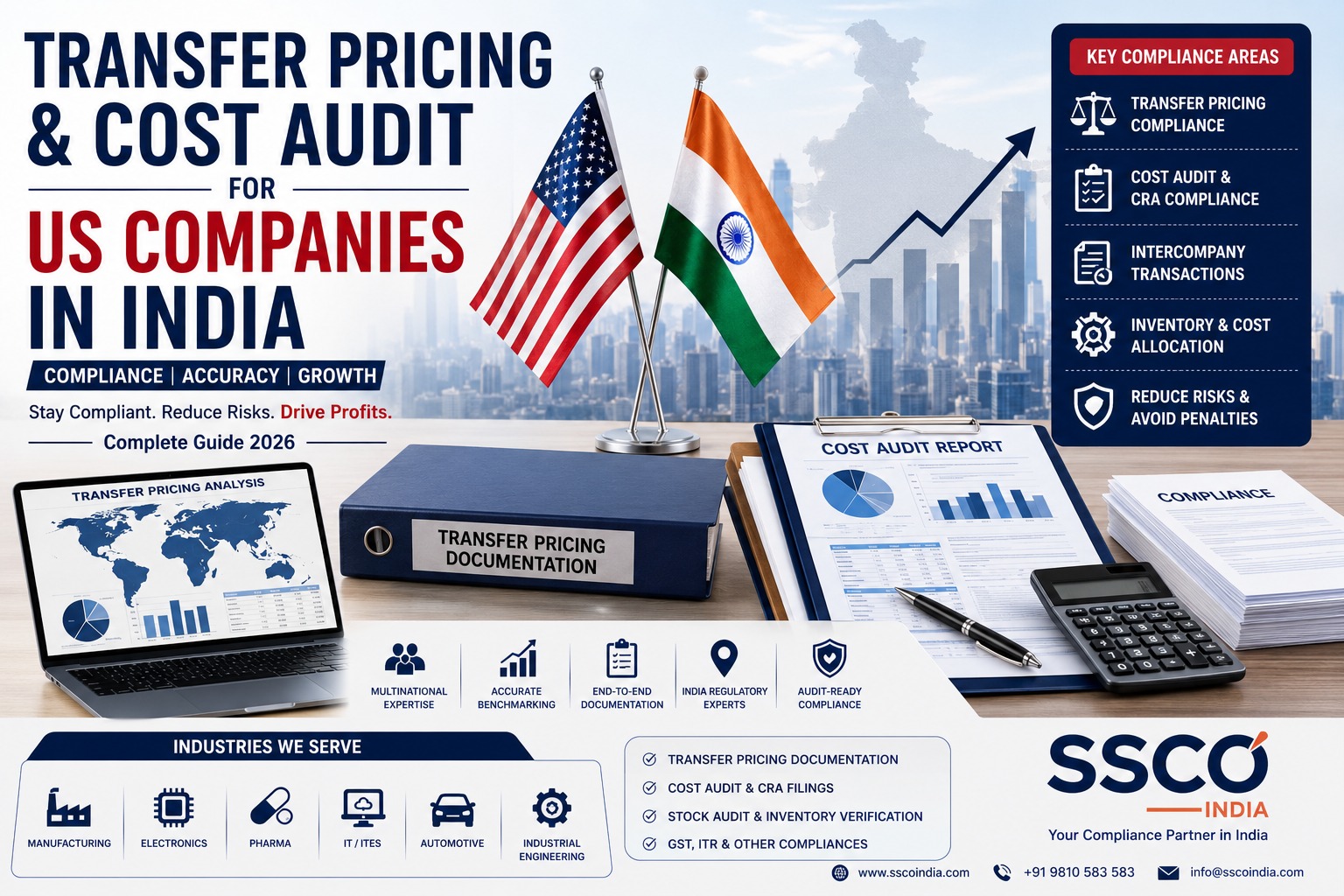
Transfer Pricing & Cost Audit for US Companies in India – Complete Guide (2026)
🧠 1. Introduction: Why Transfer Pricing & Cost Audit Matter for US Companies in India
India has become one of the most important global destinations for US multinational companies looking to expand manufacturing, technology, engineering, and shared service operations. From electronics manufacturing and pharma production to SaaS development and industrial engineering, American businesses continue investing heavily in India because of its growing economy, skilled workforce, and strategic market opportunities.
However, operating a US subsidiary or multinational business in India involves more than just commercial expansion. Foreign companies must also manage complex regulatory obligations related to:
- transfer pricing
- cost audit
- cost accounting compliance
- inventory valuation
- intercompany transactions
- tax documentation
This is where transfer pricing and cost audit for US companies in India become critically important.
“Many US companies in India face transfer pricing scrutiny and cost audit risks without realizing how closely both compliances are connected.”
Indian authorities increasingly monitor multinational businesses to ensure that:
- intercompany pricing follows arm’s length principles
- production costs are accurately reported
- inventory valuation is properly maintained
- transfer pricing documentation aligns with cost records
For US companies operating in India, this creates a dual compliance environment involving:
- Income Tax scrutiny
- MCA compliance
- transfer pricing documentation risks
- cost accounting regulations
- CRA filing requirements
Today, Indian regulators frequently compare:
- transfer pricing reports
- cost audit records
- GST filings
- financial statements
- profitability analysis
to identify discrepancies or tax risks.
This becomes especially important for US multinational businesses involved in:
- manufacturing operations
- shared service centers
- software development
- engineering services
- import/export transactions
Even small inconsistencies in:
- inventory valuation
- royalty allocation
- management fee structures
- overhead distribution
may trigger:
- transfer pricing notices
- audit observations
- regulatory scrutiny
For foreign subsidiaries operating in India, compliance is no longer optional—it is a strategic business requirement.
US companies often use global ERP systems and reporting structures that may not directly align with Indian cost accounting and regulatory frameworks. This creates significant challenges in:
- cost allocation
- production reporting
- inventory reconciliation
- transfer pricing benchmarking
As India continues strengthening multinational compliance enforcement, businesses must proactively manage both transfer pricing and cost audit together.
👉 Whether your company operates in:
- manufacturing
- technology
- engineering
- automotive
- pharma
- industrial services
…it is essential to ensure that your transfer pricing and cost audit compliance structures are fully aligned.
👉 Get expert transfer pricing and cost audit support for your US business in India with SSCOIndia.
At SSCOIndia.com, we help US companies manage:
✔ transfer pricing compliance
✔ cost audit support
✔ CRA filings
✔ stock audit & inventory verification
✔ GST & ITR compliance
✔ profitability and cost allocation review
Our team understands:
- multinational compliance challenges
- Indian regulatory frameworks
- cross-border transaction structures
helping businesses remain:
✅ compliant
✅ audit-ready
✅ operationally efficient
🇺🇸 2. Why US Companies Are Expanding Operations in India
India has emerged as one of the fastest-growing global business destinations for US multinational companies.
From manufacturing and engineering to software development and pharmaceutical production, India offers significant opportunities for businesses seeking:
- operational scalability
- market expansion
- cost optimization
- supply chain diversification
Today, many American companies are establishing:
- subsidiaries
- manufacturing units
- Global Capability Centers (GCCs)
- engineering hubs
- technology operations
across India.
🌍 India as a Global Business & Manufacturing Destination
India offers several strategic advantages for US companies:
✔ Skilled Workforce
India provides access to highly skilled professionals in:
- engineering
- software development
- manufacturing
- industrial operations
✔ Cost-Efficient Operations
Lower operational and labour costs make India highly attractive for multinational expansion.
✔ Growing Domestic Market
India’s rapidly expanding consumer and industrial sectors create strong business opportunities.
🏢 Growth of US Subsidiaries & GCCs in India
Many US multinational corporations have established:
- Global Capability Centers (GCCs)
- engineering support hubs
- manufacturing facilities
- R&D operations
in major Indian cities and industrial corridors.
These entities often manage:
- cross-border transactions
- intercompany services
- shared cost structures
- centralized procurement systems
which increase transfer pricing and cost audit complexity.
🔄 Supply Chain Diversification
Global supply chain disruptions have encouraged US companies to diversify manufacturing operations outside traditional regions.
India has become a preferred destination because of:
- manufacturing ecosystem growth
- industrial policy support
- strategic export potential
This trend is especially visible in:
- electronics manufacturing
- industrial engineering
- automotive production
- medical devices
🏭 Key Sectors Where US Companies Operate in India
⚙ Manufacturing
Industrial production and engineering operations.
📱 Electronics
Semiconductors, industrial electronics, hardware systems.
💊 Pharma
Drug manufacturing and medical device production.
💻 SaaS & IT Services
Software development and global support operations.
🚗 Automotive
Auto component and EV manufacturing businesses.
🏗 Industrial Engineering
Precision engineering and machinery manufacturing.
⚠ Compliance Obligations Increase as Operations Grow
As US businesses expand in India, regulatory compliance becomes significantly more complex.
Companies must manage:
- transfer pricing documentation
- cost audit applicability
- GST compliance
- inventory valuation
- intercompany transaction reporting
Many businesses initially focus on:
- operational setup
- hiring
- supply chain management
…but later discover that Indian compliance regulations require detailed documentation and audit readiness.
This creates:
- tax risk
- audit exposure
- compliance pressure
👉 SSCOIndia helps US multinational businesses manage transfer pricing and cost audit compliance efficiently from the beginning.
📜 3. What is Transfer Pricing in India?
Transfer pricing is one of the most important compliance areas for multinational companies operating in India.
Under Indian tax regulations, transfer pricing rules ensure that transactions between related entities are conducted at:
Arm’s Length Price (ALP)
This means that intercompany transactions must be priced similarly to transactions between unrelated parties.
📘 Transfer Pricing Under Indian Income Tax Act
Transfer pricing regulations in India are governed under:
Income Tax Act provisions relating to international transactions.
The purpose is to prevent:
- profit shifting
- tax base erosion
- artificial pricing arrangements
between associated enterprises.
🎯 Purpose of Transfer Pricing Regulations
Indian authorities use transfer pricing rules to ensure that:
- profits are fairly reported in India
- intercompany pricing reflects market value
- multinational companies do not shift profits improperly
🌍 Intercompany Transactions Covered
Transfer pricing rules apply to:
- import/export pricing
- management services
- royalty payments
- software licensing
- engineering support services
- shared cost allocation
📦 Import & Export Pricing
Many US companies import:
- raw materials
- industrial components
- machinery
- software systems
from overseas group entities.
Authorities evaluate whether pricing structures align with:
- market conditions
- arm’s length standards
- profitability expectations
💴 Royalty Payments
Royalty arrangements for:
- technology use
- intellectual property
- trademarks
- manufacturing processes
must be properly documented and benchmarked.
🏢 Shared Services & Management Fee Allocation
Multinational businesses often allocate:
- management support cost
- IT expenses
- engineering services
- corporate overheads
to Indian subsidiaries.
Improper allocation may create transfer pricing disputes.
🔍 Indian Authorities Closely Monitor Pricing Structures
Indian tax authorities increasingly analyze:
- profitability margins
- transfer pricing reports
- inventory valuation
- cost structures
especially for multinational businesses operating in:
- manufacturing
- pharma
- electronics
- IT/ITES
- automotive
👉 SSCOIndia helps US companies prepare robust transfer pricing documentation aligned with Indian regulations and operational realities.
📊 4. What is Cost Audit in India?
Cost audit is a statutory compliance process conducted under Indian law to verify:
- production cost accuracy
- inventory valuation
- operational efficiency
- cost allocation structures
It is governed under:
Section 148 of the Companies Act, 2013
and related Cost Audit Rules.
🏭 Role of Cost Audit in Manufacturing & Industrial Sectors
Cost audit plays a critical role in industries involving:
- manufacturing
- engineering
- industrial production
- chemicals
- automotive
- electronics
because it validates:
- production costing
- operational controls
- inventory systems
- cost efficiency
🌍 Why Cost Audit Matters for Multinational Companies
For US businesses operating in India, cost audit impacts:
- transfer pricing documentation
- profitability reporting
- inventory valuation
- compliance disclosures
Authorities may compare cost audit findings with:
- tax filings
- TP study reports
- financial statements
📊 Difference Between Different Types of Audit
| Audit Type | Primary Focus |
|---|---|
| Cost Audit | Production cost & operational efficiency |
| Financial Audit | Financial statements |
| Internal Audit | Internal controls |
| Transfer Pricing Assessment | Intercompany pricing |
🔍 What Cost Audit Focuses On
✔ Cost Allocation
Allocation of labour, utilities, and production overheads.
✔ Production Efficiency
Operational efficiency and manufacturing controls.
✔ Inventory Valuation
Verification of stock valuation and inventory records.
✔ Operational Cost Accuracy
Assessment of production cost structures.
👉 SSCOIndia provides specialized cost audit services for multinational and US companies operating in India.
🔄 5. How Transfer Pricing & Cost Audit Are Connected
Transfer pricing and cost audit are closely interconnected for multinational businesses operating in India.
Authorities increasingly cross-verify:
- transfer pricing reports
- cost records
- inventory valuation
- profitability analysis
to identify inconsistencies and compliance risks.
🔗 Key Areas of Linkage
📊 Transfer Pricing Reports
Intercompany pricing and benchmarking analysis.
📑 Cost Records
Manufacturing cost and production reporting.
💰 Profitability Analysis
Segment-wise profitability and operational margins.
📦 Inventory Valuation
Stock valuation and WIP reporting.
⚙ Overhead Allocation
Allocation of shared and indirect costs.
⚠ Mismatch Can Trigger Scrutiny
If transfer pricing documentation differs from:
- cost audit reports
- CRA filings
- financial statements
- GST returns
authorities may initiate:
- scrutiny assessments
- transfer pricing adjustments
- audit review
🔍 Authorities May Compare Multiple Records
Indian regulators frequently compare:
- TP study reports
- CRA filings
- GST returns
- financial disclosures
- inventory records
to evaluate consistency.
👉 SSCOIndia helps multinational companies align transfer pricing and cost audit compliance to reduce regulatory risk.
⚖️ 6. Applicability of Transfer Pricing & Cost Audit for US Companies
Understanding applicability is one of the most important compliance requirements for US businesses operating in India.
🌍 Transfer Pricing Applicability
Transfer pricing rules generally apply when companies engage in:
- international transactions
- transactions with associated enterprises
- cross-border arrangements
🏭 Cost Audit Applicability
Cost audit applicability is governed under:
Section 148 of Companies Act
and related Cost Audit Rules.
Applicability depends on:
- turnover thresholds
- sector classification
- manufacturing activities
🏢 Industries Commonly Covered
📱 Electronics
🚗 Automotive
🧪 Chemicals
💊 Pharma
⚙ Engineering
🏭 Industrial Manufacturing
These industries frequently fall under:
- cost records maintenance
- mandatory cost audit
- transfer pricing scrutiny
⚠ Important Warning
“Failure to comply may result in penalties, scrutiny, and tax adjustments.”
Non-compliance may lead to:
- regulatory notices
- transfer pricing disputes
- MCA scrutiny
- financial penalties
👉 SSCOIndia helps US companies evaluate applicability and maintain complete compliance across transfer pricing and cost audit regulations.
📑 7. Documentation & Compliance Requirements
Proper documentation is essential for multinational businesses operating in India.
📘 Transfer Pricing Documentation
✔ TP Study Report
Detailed transfer pricing analysis and justification.
✔ FAR Analysis
Functions, assets, and risk evaluation.
✔ Benchmarking Analysis
Comparison with comparable industry entities.
✔ Intercompany Agreements
Formal documentation of related-party transactions.
📘 Cost Audit Documentation
✔ CRA-1 Cost Records
Prescribed cost accounting records.
✔ Inventory Records
Stock movement and valuation details.
✔ Production Reports
Manufacturing and operational data.
✔ Cost Allocation Records
Overhead and indirect cost allocation documentation.
⚠ Accurate Documentation is Essential
Incomplete or inconsistent records may create:
- transfer pricing disputes
- audit observations
- compliance scrutiny
- tax adjustments
👉 SSCOIndia helps US companies maintain audit-ready transfer pricing and cost audit documentation aligned with Indian compliance requirements.
8. Inventory Valuation & Cost Allocation Challenges
For multinational companies operating in India, inventory valuation and cost allocation are among the most sensitive areas of transfer pricing and cost audit compliance.
US companies involved in:
- manufacturing
- electronics
- pharma
- industrial engineering
- automotive production
often manage highly complex inventory structures and cross-border cost allocation models. Even small inconsistencies in inventory reporting or production costing may create:
- transfer pricing disputes
- audit observations
- tax adjustments
- compliance scrutiny
This makes inventory valuation and cost allocation compliance for US companies in India critically important.
📊 Inventory Valuation Issues
Inventory valuation directly impacts:
- profitability analysis
- transfer pricing margins
- financial reporting
- tax liability
- cost audit disclosures
Indian authorities closely evaluate whether:
- inventory valuation methods are consistent
- imported material pricing is accurate
- production cost allocation is reasonable
Many multinational businesses struggle because global accounting policies may differ from Indian reporting expectations.
Incorrect valuation of:
- raw materials
- finished goods
- obsolete inventory
- spare parts
- semi-finished inventory
can distort:
- operating margins
- benchmark analysis
- tax reporting
⚙ WIP (Work-in-Progress) Complexities
WIP valuation is one of the most complicated areas for manufacturing companies.
US businesses operating in India frequently deal with:
- multi-stage production systems
- contract manufacturing arrangements
- centralized procurement models
- assembly-based operations
Improper WIP valuation may impact:
- inventory reporting
- profitability calculations
- cost audit findings
- transfer pricing benchmarking
Indian regulators often review whether:
- labour allocation is accurate
- overheads are properly distributed
- production stages are correctly valued
🌍 Imported Raw Material Pricing
Many US subsidiaries import:
- raw materials
- industrial components
- engineering systems
- electronic parts
- specialized chemicals
from overseas group entities.
Imported raw material pricing directly affects:
- cost of production
- inventory valuation
- transfer pricing margins
- profitability analysis
If import pricing is not aligned with:
- arm’s length principles
- benchmark standards
- operational reality
it may trigger scrutiny.
🏭 Shared Manufacturing Overheads
Multinational manufacturing operations often allocate:
- utility expenses
- machine utilization cost
- engineering support cost
- centralized procurement expenses
- administrative overheads
across multiple production units.
Improper overhead allocation can distort:
- segment profitability
- production cost
- inventory valuation
- transfer pricing analysis
Authorities frequently review whether shared expenses are allocated fairly and consistently.
🔄 ERP Reconciliation Issues
One of the biggest challenges faced by US multinational companies in India is ERP reconciliation.
Many businesses use:
- SAP
- Oracle
- global ERP structures
- centralized accounting systems
that may not align fully with Indian compliance reporting requirements.
This creates issues in:
- inventory classification
- cost allocation
- production reporting
- GST reconciliation
- cost audit documentation
👉 US companies often struggle aligning global ERP systems with Indian compliance reporting.
This mismatch frequently results in:
- inconsistent reporting
- audit observations
- transfer pricing disputes
- reconciliation delays
⚠ Why Accurate Cost Allocation Matters
Authorities increasingly compare:
- TP study reports
- inventory records
- CRA filings
- financial statements
- GST returns
to identify inconsistencies.
Even minor mismatches may create:
- transfer pricing notices
- audit scrutiny
- regulatory complications
👉 SSCOIndia helps US multinational companies manage inventory valuation, ERP reconciliation, and cost allocation compliance efficiently in India.
Our experts provide:
✔ inventory verification
✔ cost audit support
✔ transfer pricing coordination
✔ cost allocation review
✔ compliance reconciliation services
to ensure businesses remain:
✅ compliant
✅ audit-ready
✅ operationally aligned
🔍 9. Transfer Pricing Scrutiny & Risk Areas
Transfer pricing scrutiny in India has increased significantly over the last few years, especially for multinational companies operating through subsidiaries, GCCs, manufacturing units, and shared service structures.
Indian tax authorities actively evaluate whether multinational businesses are:
- shifting profits
- understating taxable income
- manipulating intercompany pricing
- reporting unreasonable margins
This makes transfer pricing risk management for US companies in India a major compliance priority.
💴 Royalty Payments
Many US companies charge royalties for:
- technology usage
- software licensing
- trademarks
- manufacturing know-how
- intellectual property rights
Indian authorities closely analyze whether royalty rates are:
- commercially justified
- supported by agreements
- aligned with benchmark standards
Improper royalty structures may result in:
- transfer pricing adjustments
- disallowance of expenses
- scrutiny assessments
🏢 Management Fees
Multinational companies frequently allocate:
- management support costs
- IT support services
- consulting expenses
- administrative assistance
to Indian subsidiaries.
Authorities often question whether:
- services were actually received
- charges are properly documented
- allocations are commercially reasonable
Weak documentation may create major compliance risk.
📦 Import Pricing
Import pricing is one of the most scrutinized transfer pricing areas for manufacturing businesses.
Authorities review:
- component pricing
- raw material imports
- machinery imports
- intercompany procurement structures
to evaluate whether pricing reflects:
- arm’s length principles
- industry profitability standards
⚠ Profit Shifting Concerns
Indian authorities actively monitor whether multinational companies are artificially shifting profits outside India through:
- inflated imports
- excessive royalty charges
- unreasonable service fees
- manipulated cost allocation
This is especially important for multinational manufacturing and technology businesses.
📈 Margin Benchmarking
Transfer pricing assessments often involve:
- benchmarking profitability margins
- comparing operational performance with industry peers
- reviewing segment profitability
If a company’s margins differ significantly from industry comparables, authorities may initiate scrutiny.
🔍 Industries Under Higher Scrutiny
Certain industries face significantly higher transfer pricing scrutiny in India.
📱 Electronics
High import dependency and component pricing complexity.
💊 Pharma
Licensing structures, royalties, and IP-based transactions.
🚗 Automotive
Cross-border manufacturing and component imports.
💻 IT/ITES
Shared services and intercompany cost allocation.
⚠ Regulatory Trend
Indian tax authorities closely analyze multinational profitability patterns to identify:
- pricing inconsistencies
- abnormal margins
- cost allocation issues
- tax base erosion risks
👉 SSCOIndia helps US companies strengthen transfer pricing compliance and reduce scrutiny risk through accurate documentation and coordinated audit support.
⚠️ 10. Common Compliance Mistakes US Companies Make
Many multinational businesses operating in India unknowingly create compliance gaps due to differences between US and Indian regulatory systems.
“These compliance gaps often trigger transfer pricing notices and audit complications.”
❌ Incorrect Transfer Pricing Benchmarking
Improper selection of comparable companies or inaccurate profitability analysis may create transfer pricing disputes.
❌ Ignoring Cost Audit Applicability
Many foreign subsidiaries assume cost audit rules do not apply to them.
This often leads to:
- delayed compliance
- MCA notices
- penalties
❌ Delayed CRA Filings
Late filing of:
- CRA-2
- CRA-3
- CRA-4
creates serious compliance exposure.
❌ Improper Cost Allocation
Incorrect allocation of:
- labour expenses
- shared services
- utilities
- manufacturing overheads
may distort:
- transfer pricing margins
- profitability analysis
- inventory valuation
❌ Inventory Mismatch
Mismatch between:
- inventory records
- GST returns
- financial statements
- cost audit reports
may trigger scrutiny.
❌ ERP Reporting Inconsistency
Global ERP systems often fail to align fully with Indian reporting requirements.
This creates:
- reconciliation gaps
- reporting inconsistency
- audit observations
❌ Weak Documentation
Incomplete or inconsistent documentation is one of the biggest reasons multinational companies face:
- transfer pricing scrutiny
- tax notices
- audit complications
👉 SSCOIndia helps multinational businesses identify compliance gaps early and strengthen audit readiness across transfer pricing and cost audit frameworks.
💰 11. Penalties for Non-Compliance
Failure to comply with transfer pricing and cost audit regulations in India may result in serious financial and operational consequences.
⚠ Transfer Pricing Penalties
❌ Underreporting
Incorrect pricing or profit reporting may result in tax adjustments and penalties.
❌ Documentation Failure
Failure to maintain proper TP documentation may trigger penalties.
❌ Incorrect Disclosures
Improper reporting of international transactions creates compliance exposure.
⚠ Cost Audit Penalties
❌ Non-Filing
Failure to complete mandatory CRA filings may result in penalties.
❌ Delayed CRA Submissions
Late filing increases scrutiny risk.
❌ Improper Records Maintenance
Incomplete cost records may create audit observations and compliance notices.
🚨 Possible Consequences
Non-compliance may result in:
- tax adjustments
- MCA notices
- scrutiny assessments
- operational complications
- increased regulatory monitoring
⚠ Directors & Officers May Also Face Consequences
In certain situations, directors and responsible officers may also face regulatory action under Indian law.
👉 SSCOIndia helps US companies reduce compliance exposure through proactive transfer pricing and cost audit management.
🧠 12. Why US Companies Need Professional Support
Managing transfer pricing and cost audit compliance in India requires specialized expertise.
For multinational businesses, internal compliance management often becomes highly complex.
⚖ Understanding Indian Tax & MCA Regulations
US companies must comply with:
- Income Tax regulations
- Companies Act provisions
- CRA rules
- GST requirements
- transfer pricing regulations
These frameworks require detailed technical knowledge.
🌍 Managing Cross-Border Transactions
Multinational companies regularly deal with:
- imports
- exports
- royalties
- shared services
- intercompany pricing structures
which increases compliance complexity.
🔄 Aligning US Accounting Systems with Indian Compliance
US accounting systems and ERP structures may not align directly with Indian cost accounting and reporting formats.
This creates:
- reconciliation issues
- reporting inconsistency
- audit complexity
🏭 Managing Multi-Location Operations
Manufacturing and industrial businesses operating:
- multiple factories
- warehouses
- shared service centers
face additional compliance challenges.
🔗 Coordinating TP & Cost Audit Together
Transfer pricing and cost audit are no longer separate compliance functions.
Indian authorities increasingly cross-verify:
- financial records
- tax filings
- cost records
- transfer pricing documentation
for consistency.
👉 Professional support helps businesses:
✔ reduce scrutiny risk
✔ improve audit readiness
✔ strengthen compliance controls
✔ avoid penalties
🏆 13. Why Choose SSCOIndia for Transfer Pricing & Cost Audit Services
👉 SSCOIndia.com is a trusted compliance partner for US multinational companies operating in India.
👨💼 Experienced Compliance Professionals
Our team includes experts specializing in:
- transfer pricing
- cost audit
- multinational compliance
- inventory verification
🌍 Expertise in US Company Compliance
We understand the compliance challenges faced by:
- US subsidiaries
- multinational manufacturers
- GCCs
- industrial businesses
📑 End-to-End TP + Cost Audit Support
We provide complete support for:
✔ transfer pricing documentation
✔ benchmarking analysis
✔ cost audit compliance
✔ CRA filings
✔ inventory verification
📍 Delhi/NCR-Based Professional Team
Our Delhi/NCR-based experts support multinational businesses operating across India.
🔗 Integrated Compliance Services
SSCOIndia also provides:
✔ stock audit
✔ GST compliance
✔ ITR filing
✔ inventory verification
✔ CRA compliance support
🏭 Industry Experience
We have experience supporting:
- manufacturing companies
- electronics businesses
- pharma companies
- automotive manufacturers
- multinational subsidiaries
operating in India.
📣 14. Get Expert Transfer Pricing & Cost Audit Support for Your US Business
⚠️ Avoid transfer pricing disputes and cost audit penalties in India.
⚠️ Get expert compliance support for your US business operating in India.
With SSCOIndia.com, you get:
✔ Free consultation
✔ Fast turnaround
✔ End-to-end compliance management
✔ Transfer pricing support
✔ Cost audit & CRA filing assistance
✔ Inventory verification support
📞 Contact SSCOIndia today and ensure your India operations remain compliant, audit-ready, and operationally efficient.
❓ 15. FAQs – Transfer Pricing & Cost Audit for US Companies in India
❓ What is transfer pricing in India?
Transfer pricing refers to pricing rules applicable to transactions between related entities operating across countries.
❓ Is transfer pricing mandatory for US companies in India?
Yes, transfer pricing regulations apply when companies engage in specified international transactions with associated enterprises.
❓ How is cost audit linked with transfer pricing?
Cost audit records impact profitability analysis, inventory valuation, and transfer pricing benchmarking.
❓ What industries fall under cost audit applicability?
Industries such as:
- electronics
- automotive
- chemicals
- engineering
- pharma
- industrial manufacturing
commonly fall under applicability criteria.
❓ What is CRA-1 compliance?
CRA-1 relates to maintenance of prescribed cost records under Indian regulations.
❓ What happens if transfer pricing documentation is incorrect?
Incorrect documentation may lead to scrutiny, tax adjustments, and penalties.
❓ Can US accounting standards be used for Indian compliance?
US accounting systems may be used internally, but Indian compliance reporting must align with Indian regulations.
❓ What are penalties for non-compliance?
Penalties may include:
- tax adjustments
- MCA notices
- regulatory scrutiny
- financial penalties
- operational complications.