Introduction
In today’s fast-growing startup ecosystem, founders often focus on product, funding, and scaling—but overlook one critical area: ITR filing for startups in India. Whether you’re a bootstrapped startup or venture-funded company, income tax compliance is mandatory from day one.
Many founders believe that if their startup is not profitable, there is no need to file an income tax return. This is one of the biggest misconceptions. Even loss-making startups must file ITR, and failure to do so can result in penalties, notices, and loss of future tax benefits.
Under evolving startup income tax India regulations, authorities track financial data through multiple sources like GST, bank transactions, and investor reporting. This makes how startups file income tax return a crucial compliance decision—not just a formality.
Startups also deal with complex areas like funding, share premium, and carry forward of losses—making tax filing more technical than a regular business.
👉 Avoid penalties by filing correctly with experts like SSCOIndia.
We help startups stay compliant from day one, ensuring accurate filing and zero compliance risks.
What is Considered a Startup in India?
Before understanding taxation, it’s important to define what qualifies as a startup. As per Startup India, a startup is an entity recognized by DPIIT that meets specific criteria.
📊 DPIIT Recognition Criteria:
- Age of entity should be less than 10 years
- Annual turnover should not exceed ₹100 crore
- Business should be innovation-driven or scalable
Understanding this startup definition in India for income tax is important because many tax benefits are available only to DPIIT-recognized startups.
Types of Startup Entities:
1. Private Limited Company
Most common structure for startups, especially those seeking funding.
2. LLP (Limited Liability Partnership)
Preferred for small startups or service-based businesses.
3. Partnership Firm
Less common for scalable startups but still applicable in some cases.
Each structure has different compliance and tax filing requirements. This is why understanding the DPIIT startup meaning and entity structure is essential before filing ITR.
👉 Confused about your startup classification?
SSCOIndia helps founders choose the right structure and ensures accurate tax compliance from the beginning.
Is ITR Filing Mandatory for Startups?
One of the most searched questions is: Is ITR mandatory for startups?
The answer is a clear YES.
As per rules laid down by the Income Tax Department India, ITR filing is compulsory for all registered entities, regardless of income or profitability.
Mandatory Even If:
- Your startup has no income
- You are only incurring expenses or losses
- You are in the early stage or pre-revenue phase
Cases Where Filing is Compulsory:
- All private limited companies (even zero revenue)
- LLPs and partnership firms
- Startups claiming loss carry forward
- Startups that have received funding or investments
Not filing ITR means:
- You lose the benefit of carrying forward losses
- Increased risk of income tax notices
- Compliance issues during funding rounds
Understanding startup ITR rules in India is critical for long-term growth.
👉 Don’t miss compliance in the early stage.
With SSCOIndia, your startup’s ITR is filed correctly, helping you stay investor-ready and fully compliant.
Which ITR Form is Applicable for Startups?
Choosing the correct form is essential for accurate ITR filing for startups. The form depends on your business structure.
Applicable ITR Forms:
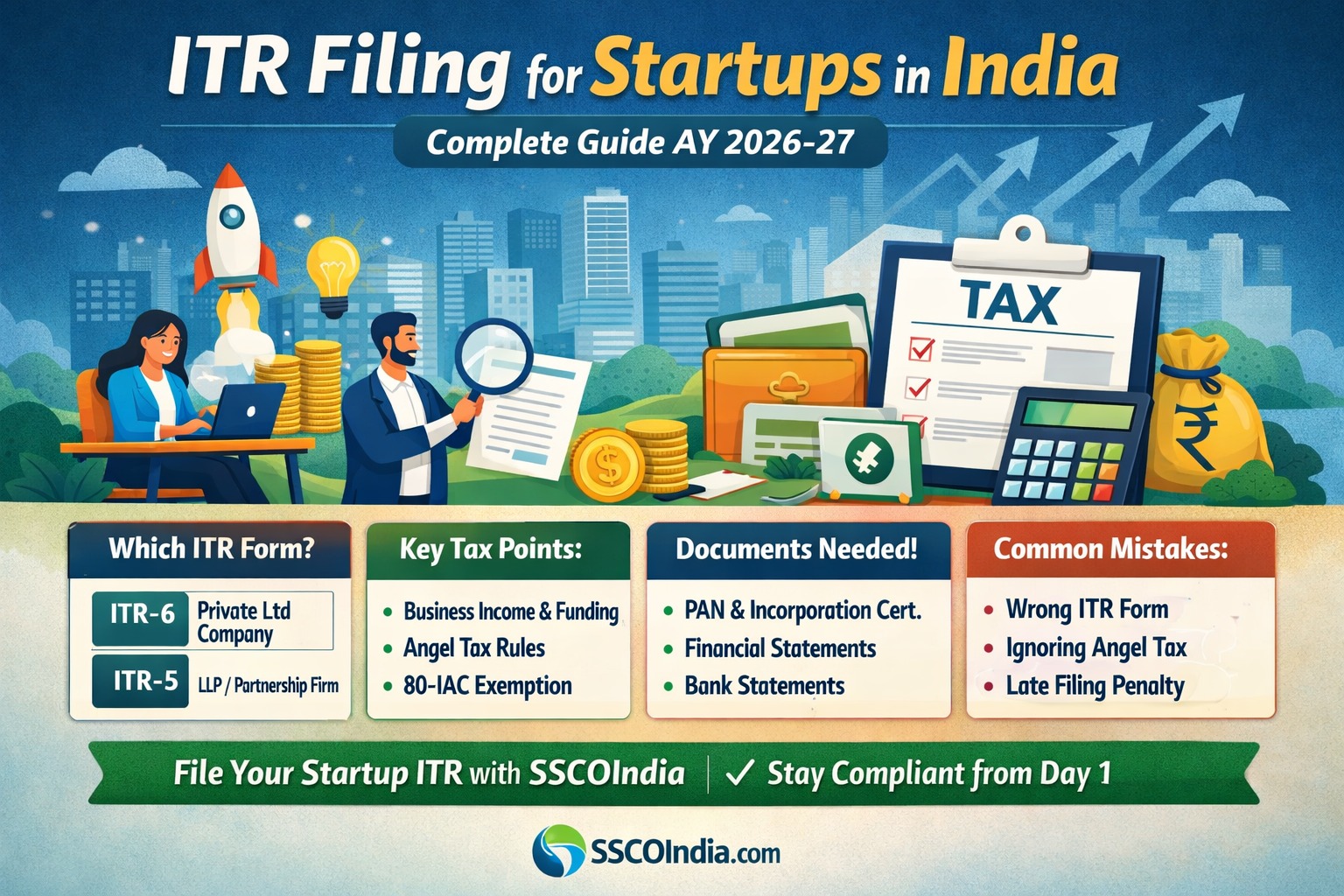
| Entity Type | ITR Form |
|---|---|
| Private Limited Company | ITR-6 |
| LLP | ITR-5 |
| Partnership Firm | ITR-5 |
Important Points:
- ITR-6 is mandatory for companies (except those claiming exemption under Section 11)
- Filing must be done digitally using DSC (Digital Signature Certificate)
- Incorrect form selection can lead to defective return notices
Keywords like “ITR form for startup company” and “ITR 6 for private limited company” are highly searched because many founders make mistakes here.
👉 Get it right the first time.
SSCOIndia ensures correct ITR form selection and error-free filing for startups, avoiding rejection and penalties.
Income Sources & Taxation for Startups
Understanding startup taxation in India is crucial for proper reporting and tax planning. Startups often have multiple income streams beyond just business revenue.
Business Income
Revenue generated from core operations is taxed under “Profits & Gains from Business or Profession.”
Funding & Investment
Startups receive funding through:
- Angel investors
- Venture capital firms
- Share premium
Angel Tax (Section 56) may apply if share valuation is not justified.
Other Income
- Interest from bank accounts
- Capital gains from investments
Special Considerations:
- Angel Tax applicability for startups
- MAT (Minimum Alternate Tax) for companies
Misreporting these incomes can result in heavy tax liabilities and scrutiny.
👉 Simplify complex startup taxation.
SSCOIndia provides expert guidance on angel tax, funding compliance, and income classification, ensuring optimized tax liability.
Tax Benefits Available for Startups
One of the biggest advantages of being a recognized startup is access to tax benefits. Understanding startup tax exemption in India can significantly reduce your tax burden.
Key Tax Benefits:
1. Section 80-IAC Deduction
Eligible startups can claim 100% tax exemption on profits for 3 consecutive years.
2. Carry Forward of Losses
Startups can carry forward losses even with a change in shareholding (subject to conditions).
3. Capital Gains Exemption
Certain exemptions are available on reinvestment.
4. DPIIT Benefits
Recognized startups enjoy multiple regulatory and tax relaxations.
Keywords like “80IAC deduction startup” are highly searched because founders want to reduce taxes legally.
👉 Don’t miss out on tax savings.
SSCOIndia helps startups identify and claim maximum tax benefits, improving cash flow and growth potential.
Common Mistakes Startups Make in ITR Filing
Many startups face compliance issues due to avoidable mistakes during ITR filing for startups.
Not Filing ITR in Loss Years
Even if your startup has no profit, filing is mandatory to carry forward losses.
Choosing Wrong ITR Form
Using incorrect forms leads to rejection or notices.
Ignoring Angel Tax Provisions
Improper valuation of shares can trigger tax under Section 56.
Not Maintaining Proper Books
Lack of financial records leads to inaccurate reporting.
Missing Audit Requirements
Certain startups require tax audit—missing this can result in penalties.
These mistakes can impact funding, compliance, and long-term growth.
👉 Avoid these costly errors.
With SSCOIndia, your startup gets professional ITR filing, compliance checks, and expert tax guidance, ensuring smooth operations and investor confidence.
Documents Required for Startup ITR Filing
For smooth and error-free ITR filing for startups in India, having the right documentation is essential. Many startups face delays or notices simply because of incomplete or incorrect documentation.
📄 Key Documents Required for Startup ITR:
- PAN of the Company / LLP
- Certificate of Incorporation
- Financial Statements
- Profit & Loss Account
- Balance Sheet
- Audit Report (if applicable)
- Bank Statements (all business accounts)
- Investment Details
- Shareholding pattern
- Funding details (angel/VC investments)
These documents required for startup ITR help ensure accurate reporting of income, expenses, and compliance with tax laws.
⚠️ Common Issues:
- Missing financial records
- Incorrect classification of expenses
- Incomplete funding disclosures
Even small errors in documentation can lead to mismatches with AIS or trigger scrutiny.
👉 Don’t risk errors due to incomplete paperwork.
SSCOIndia ensures proper document verification and preparation before filing your startup ITR, giving you 100% accurate and compliant returns.
Step-by-Step Process to File Startup ITR
Understanding how startups file income tax return in India is crucial, especially for founders handling compliance for the first time.
Step 1: Prepare Financial Statements
Create accurate Profit & Loss and Balance Sheet based on your books of accounts.
Step 2: Conduct Audit (If Required)
If your startup crosses turnover thresholds or meets audit criteria, a tax audit is mandatory.
Step 3: Select the Correct ITR Form
- Private Limited Company → ITR-6
- LLP / Partnership → ITR-5
Step 4: File ITR Online Using DSC
Companies must file returns digitally using a Digital Signature Certificate (DSC).
Step 5: Verify the Return
Verification completes the filing process and confirms submission.
While the process seems straightforward, practical challenges include:
- Correct income classification
- Angel tax reporting
- Compliance with audit provisions
👉 Avoid confusion and costly mistakes.
SSCOIndia offers end-to-end support for startup ITR filing, ensuring each step is handled professionally and accurately.
Penalties & Compliance Risks
Ignoring or incorrectly filing startup income tax in India can lead to serious consequences. Understanding these risks helps founders stay proactive.
1. Late Filing Penalty
Startups may face penalties for delayed filing, impacting cash flow.
2. Loss of Carry Forward of Losses
If ITR is not filed on time, startups cannot carry forward losses—leading to higher future tax liability.
3. Income Tax Notices
Mismatch in data, incorrect reporting, or missing disclosures can trigger notices from the department.
4. Disqualification & Compliance Issues
Repeated non-compliance can affect company credibility and create legal complications.
Keywords like “startup itr penalties India” and “income tax compliance risks startups” are highly searched because founders often realize the impact too late.
👉 Stay safe from penalties and notices.
With SSCOIndia, your startup gets timely and accurate ITR filing, ensuring complete compliance and zero risk.
Why Startups Should Not Ignore ITR Filing
Many early-stage founders underestimate the importance of ITR filing for startups, but it plays a critical role in business growth.
🚀 Why It Matters:
1. Funding Rounds
Investors require properly filed ITRs and financial records before investing.
2. Investor Due Diligence
Clean compliance history increases trust and valuation.
3. Bank Loans & Credit Facilities
Banks check ITR filings before approving loans.
4. Compliance Credibility
Regular filing builds a strong legal and financial foundation.
Failing to file ITR can:
- Delay funding opportunities
- Reduce investor confidence
- Create compliance hurdles
👉 Build a strong financial foundation.
SSCOIndia helps startups maintain clean and compliant tax records, making them investor-ready and growth-focused.
Startup success is not just about innovation—it’s also about strong financial and tax compliance.
At SSCOIndia, we specialize in:
Startup ITR filing services
Expert tax planning for founders
Angel tax compliance & advisory
Audit support & compliance management
End-to-end startup taxation solutions
Whether you’re a newly incorporated startup or scaling rapidly with funding, we ensure your compliance is accurate, optimized, and stress-free.
👉 File your startup ITR with SSCOIndia and stay compliant from Day 1.
Let experts handle your taxes while you focus on growing your startup.
FAQs (Featured Snippet Ready)
❓ Is ITR mandatory for startups with no income?
Yes, ITR filing for startups is mandatory, even if there is no income or only losses.
❓ Which ITR form for private limited startup?
Private limited startups must file ITR-6.
❓ What is angel tax?
Angel tax refers to tax on excess share premium received by startups under Section 56.
❓ Can startups carry forward losses?
Yes, startups can carry forward losses if ITR is filed within the due date.
❓ Is audit compulsory for startups?
Audit is required if turnover exceeds prescribed limits or specific conditions are met.
Conclusion
Filing ITR for startups in India is not just a compliance requirement—it is a foundation for long-term growth, funding, and credibility.
From choosing the correct ITR form to reporting funding, claiming tax benefits, and maintaining proper documentation, every step matters. Early-stage mistakes can lead to penalties, missed opportunities, and compliance challenges later.
That’s why startups should focus on getting their tax compliance right from the beginning.
👉 Choose SSCOIndia for hassle-free startup compliance.
We ensure your startup stays compliant, optimized, and ready for the next stage of growth.
Get started today and file your startup ITR with confidence.